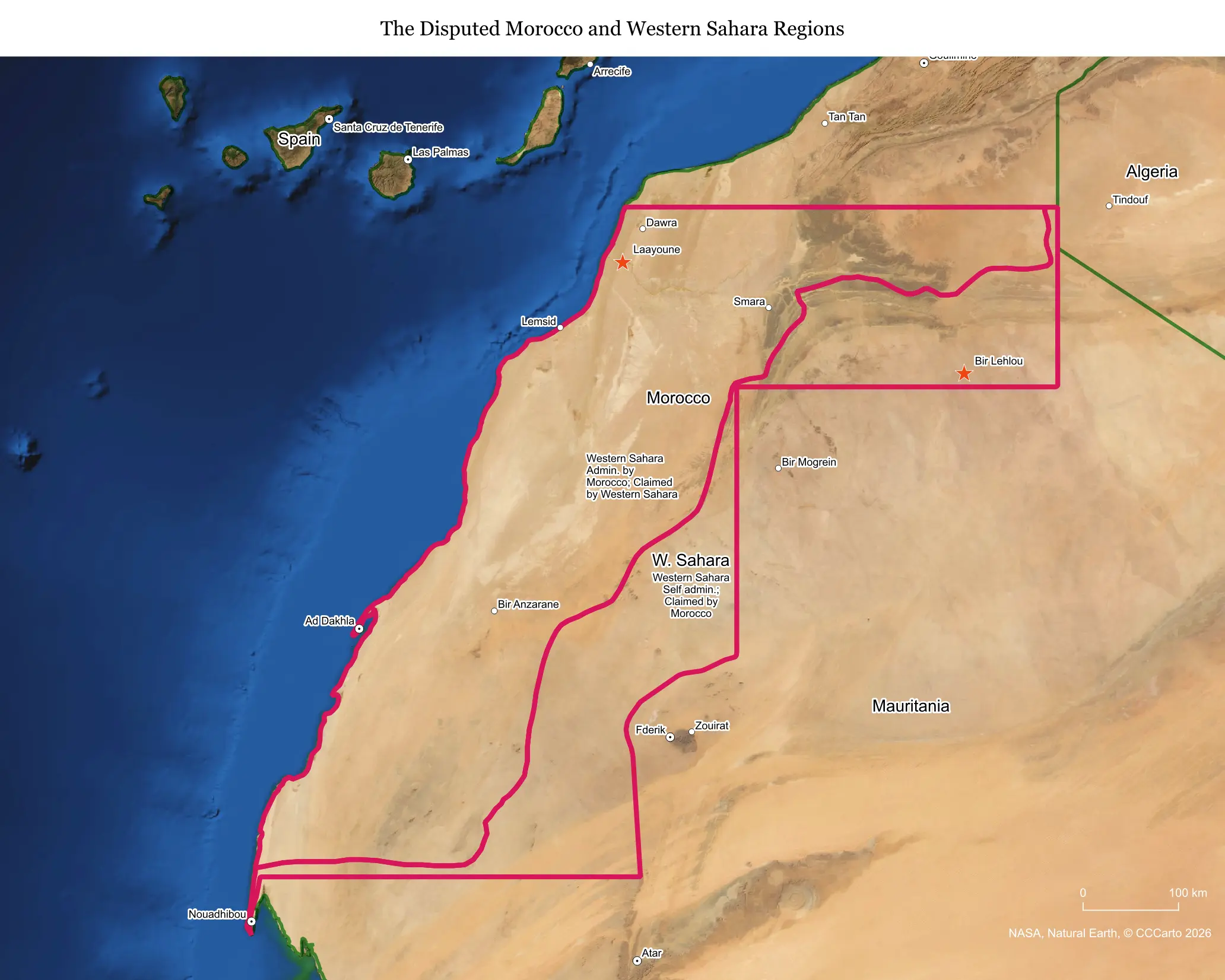
What makes this territory disputed
Western Sahara is a former Spanish colony that Spain abandoned in 1975 without a clear transfer of sovereignty, leaving Morocco to claim and occupy most of the territory while the Polisario Front, representing the indigenous Sahrawi people, declared an independent Sahrawi Arab Democratic Republic. The UN still classifies it as one of the world's last non-self-governing territories awaiting a decision on decolonization, a rare and long-standing designation.
Who is involved, and for how long
The core dispute is between Morocco and the Algeria-backed Polisario Front, active since Spain's withdrawal in 1975. A guerrilla war ran until a 1991 UN-brokered ceasefire that promised a self-determination referendum, one that has never been held; low-level fighting resumed in 2020 after the Polisario declared the truce over, ending nearly three decades of relative calm.
Resources and strategic value
Western Sahara holds some of the world's largest phosphate reserves, a critical input for fertilizer production, along with rich Atlantic fishing grounds and significant wind-energy potential; possible offshore oil and gas deposits have also drawn periodic exploration interest. These resources are central to why Morocco has invested heavily in the territory and why international buyers and courts have repeatedly scrutinized whether trade deals covering Western Saharan products are legal.
Who lives there and what's on the land today
Morocco has built cities, ports, and infrastructure in its zone, home to roughly 600,000 people, a mix of indigenous Sahrawis and Moroccan settlers encouraged to relocate there over decades. Tens of thousands of Sahrawi refugees have lived for generations in camps near Tindouf in neighboring Algeria, in a displacement crisis with no resolution in sight.
Is the boundary stable?
The Berm, a heavily fortified sand wall lined with landmines that Morocco built in the 1980s, has functioned as the de facto dividing line for decades and remains largely unchanged physically. However, the 2020 collapse of the ceasefire reintroduced sporadic low-intensity fighting along parts of the line that had been quiet since 1991.
Is a resolution coming?
Momentum has shifted substantially toward a settlement based on Moroccan sovereignty. The UN Security Council's October 2025 Resolution 2797 endorsed Morocco's autonomy plan as the negotiating basis, the EU aligned its position in January 2026, and secret talks in Madrid in February 2026 brought all key parties together for the first time in years, though the Polisario Front and Algeria continue to reject anything short of a full independence referendum.
Does this dispute affect the world?
Yes. The US recognized Moroccan sovereignty over Western Sahara in 2020 as part of Morocco's normalization with Israel, and EU courts have repeatedly struck down trade agreements with Morocco for improperly including Western Saharan goods and fish without Sahrawi consent, creating an ongoing legal and diplomatic tangle. Its resolution or continued stalemate also shapes Morocco-Algeria relations, already severely strained, and broader African Union politics given the unusual step of admitting the Sahrawi Republic as a member.
Sources
- UN Security Council Report: Western Sahara, April 2026 Monthly Forecast
- Human Rights Watch: UN: Western Sahara Peoples' Self-Determination at Risk
- BBC News: Morocco Declares Public Holiday to Mark UN Approval of Its Western Sahara Plan
- EUobserver: EU Backs Morocco's Plan for Western Sahara
- The New Arab: Sahara Autonomy Plan Revealed After Morocco-Polisario Meeting