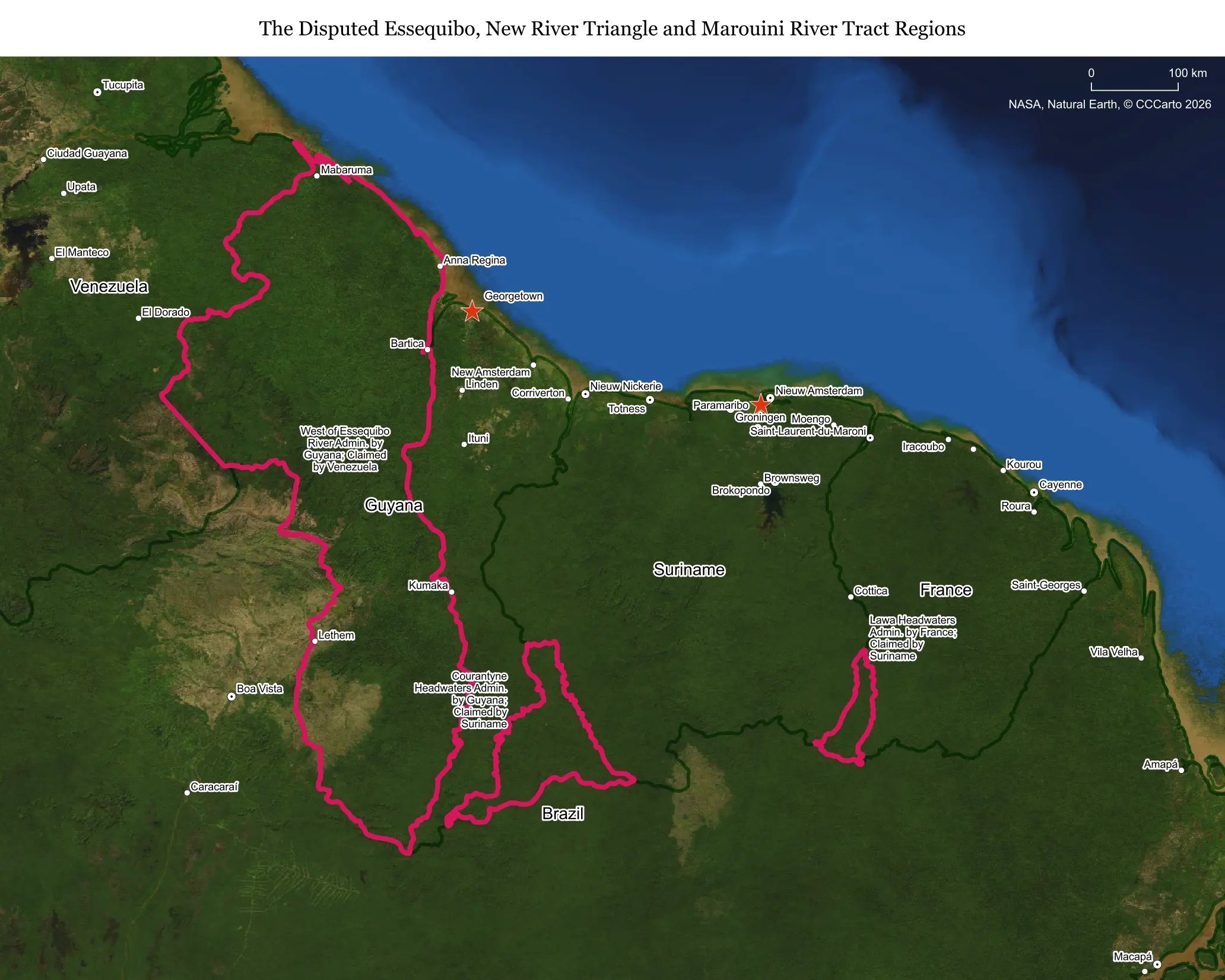
What makes this territory disputed
Essequibo is a vast region making up roughly two-thirds of Guyana's land area, bordered by the Essequibo River, and administered by Guyana since a 1899 international arbitration awarded it to what was then British Guiana. Venezuela accepted that boundary for more than 60 years before reversing its position in 1966, on the eve of Guyana's independence, arguing the original arbitration was invalid due to alleged collusion between British and Russian arbitrators.
Who is involved, and for how long
The dispute is between Venezuela and Guyana, and it has run since Venezuela's 1962 revival of its claim, intensifying sharply after a major offshore oil discovery near Essequibo's coast in 2015 and again in 2023 when Venezuela held a domestic referendum asserting sovereignty over the region. Guyana took the case to the International Court of Justice, which has ruled twice on jurisdiction in Guyana's favor before moving to public merits hearings that opened in May 2026.
Resources and strategic value
Essequibo is extraordinarily resource-rich: it holds gold, diamonds, and valuable timber onshore, while its adjacent offshore waters have become one of the world's most significant new oil frontiers since 2015, transforming Guyana into a country with some of the highest per-capita crude reserves anywhere. That oil boom has driven explosive Guyanese economic growth, with GDP rising 63% in 2022 and 43% in 2024, making the stakes of the dispute far higher today than when it was dormant for six decades.
Who lives there and what's on the land today
Roughly 125,000 to 150,000 people live in the Essequibo region under Guyanese governance, administration, schools, and infrastructure, alongside major international oil operations run by companies including ExxonMobil and Chevron in nearby waters. Guyana's government has continued to grant licenses and develop the area as an integral part of the country, while Venezuela has passed domestic legislation purporting to create administrative structures over the territory without any actual presence on the ground.
Is the boundary stable?
It had been stable for over a century under the 1899 award, but Venezuela's 2023 referendum and subsequent 'Organic Law' claiming to formally incorporate Essequibo marked a serious escalation, prompting Guyana to seek and win emergency protective measures from the ICJ in December 2023 ordering Venezuela not to alter the status quo. No physical territory has changed hands, but the political temperature has risen sharply compared to the dispute's long dormant decades.
Is a resolution coming?
The ICJ opened week-long public hearings on the merits of the case in May 2026, a major step after years of jurisdictional wrangling, though a final ruling was not expected immediately and Venezuela does not recognize the court's authority to bind it. Adding further uncertainty, a January 2026 US military operation captured Venezuelan President Nicolás Maduro, installing an interim government under Delcy Rodríguez whose long-term position on Essequibo, and on complying with any ICJ ruling, remains unclear.
Does this dispute affect the world?
Yes, significantly. The case tests whether century-old international arbitration awards can be considered final and binding, a question with implications well beyond South America; it also concerns major global oil companies and markets given the scale of Guyana's offshore reserves. Guyana has drawn public support from CARICOM, the Commonwealth, the European Union, and the Organization of American States, while the dramatic change in Venezuela's own government adds a new layer of geopolitical unpredictability to how the dispute will ultimately be resolved.
Sources
- Washington Post: Guyana and Venezuela Return to UN Court to Settle Historic Dispute
- JURIST: ICJ Opens Oral Hearings as Guyana Asks Court to Affirm Century-Old Boundary
- UPI: Venezuela, Guyana Resume Hearings Over Disputed, Oil-Rich Essequibo
- UK House of Commons Library: The US Capture of Nicolás Maduro
- Library of Congress: FALQs: Guyana-Venezuela Territorial Dispute