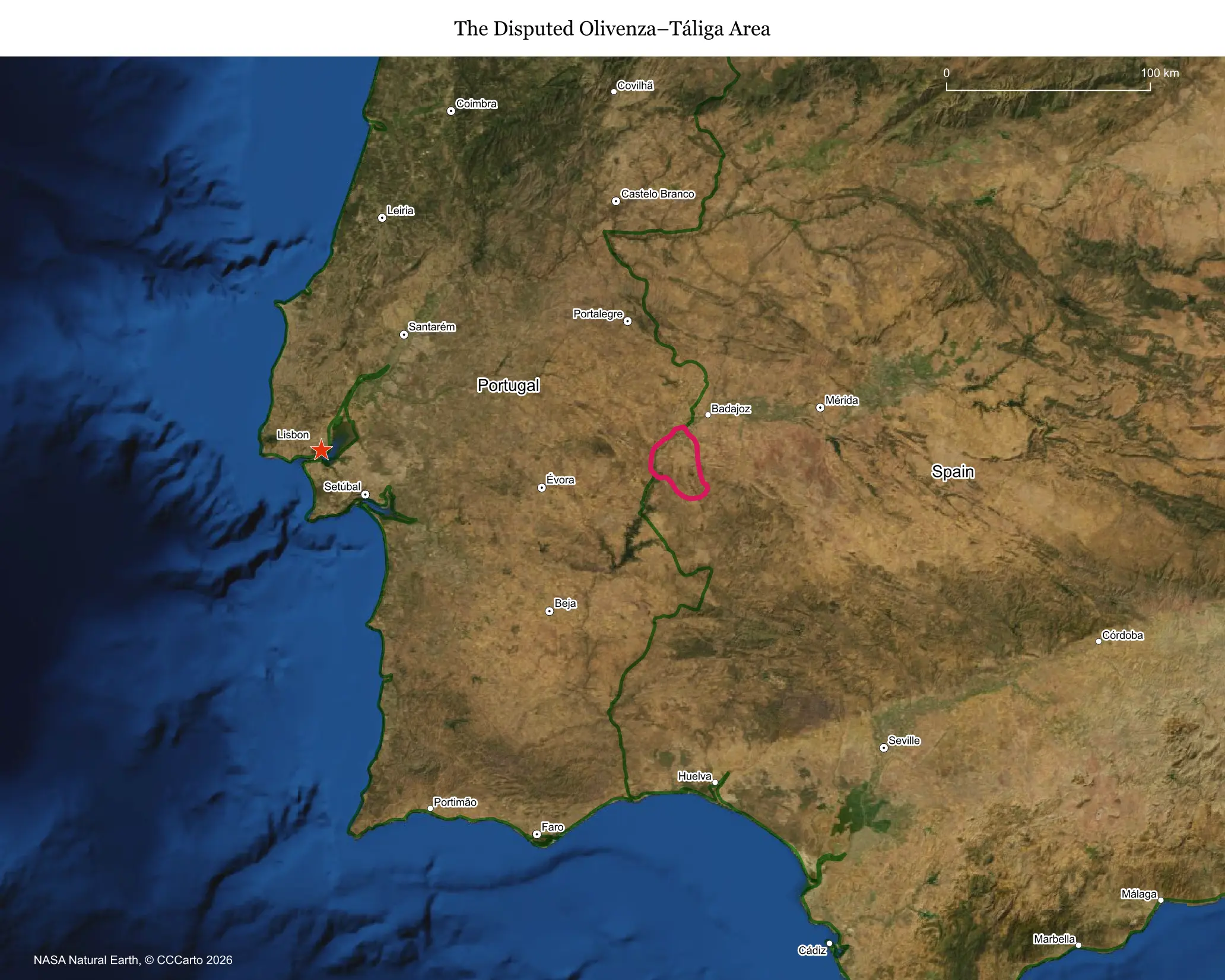
What makes this territory disputed
Olivenza, along with the smaller nearby settlement of Táliga, was Portuguese territory until Spain seized it during the brief 1801 War of the Oranges. The 1815 Treaty of Vienna, part of the broader Congress of Vienna settlement after the Napoleonic Wars, formally required Spain to return the area to Portugal, a provision Spain has simply never carried out, leaving a technical legal dispute that has persisted for over two centuries.
Who is involved, and for how long
The dispute is between Spain and Portugal and has technically remained open since 1815, making it one of the oldest continuously unresolved territorial claims in Europe. In practice, however, neither government has treated it as a live issue for generations; it exists almost entirely as a historical and legal footnote rather than an active diplomatic dispute.
Resources and strategic value
Olivenza has no strategic or resource significance today. It is a modest agricultural area in Spain's Extremadura region, with no major industry, minerals, or geopolitical importance that would give either country a strong practical incentive to revisit the matter.
Who lives there and what's on the land today
Around 12,000 people live in Olivenza today, fully integrated into Spain with Spanish schools, governance, and identity; there is no meaningful Portuguese cultural or political presence, and residents overwhelmingly consider themselves Spanish rather than caught between two nations.
Is the boundary stable?
Completely and uneventfully stable for more than 200 years. This is about as dormant as a territorial dispute can be: no incidents, no competing administration, and no practical ambiguity about which country actually governs the area day to day.
Is a resolution coming?
There is no active process, and none appears necessary in practice. Portugal occasionally reaffirms its historical legal position as a matter of record, but with both countries fully integrated into the EU and the Schengen open-border area, there is essentially no functional border to renegotiate regardless of the two-century-old treaty language.
Does this dispute affect the world?
No meaningful effect. It is mainly of interest to historians and as a curiosity in discussions of Europe's oldest unresolved territorial claims, illustrating how a dispute can remain technically open for centuries once immediate practical stakes disappear.
Sources
- Encyclopaedia Britannica: Congress of Vienna
- Instituto Geográfico Nacional (Spain): IGN — Spain
- Wikipedia: Olivenza