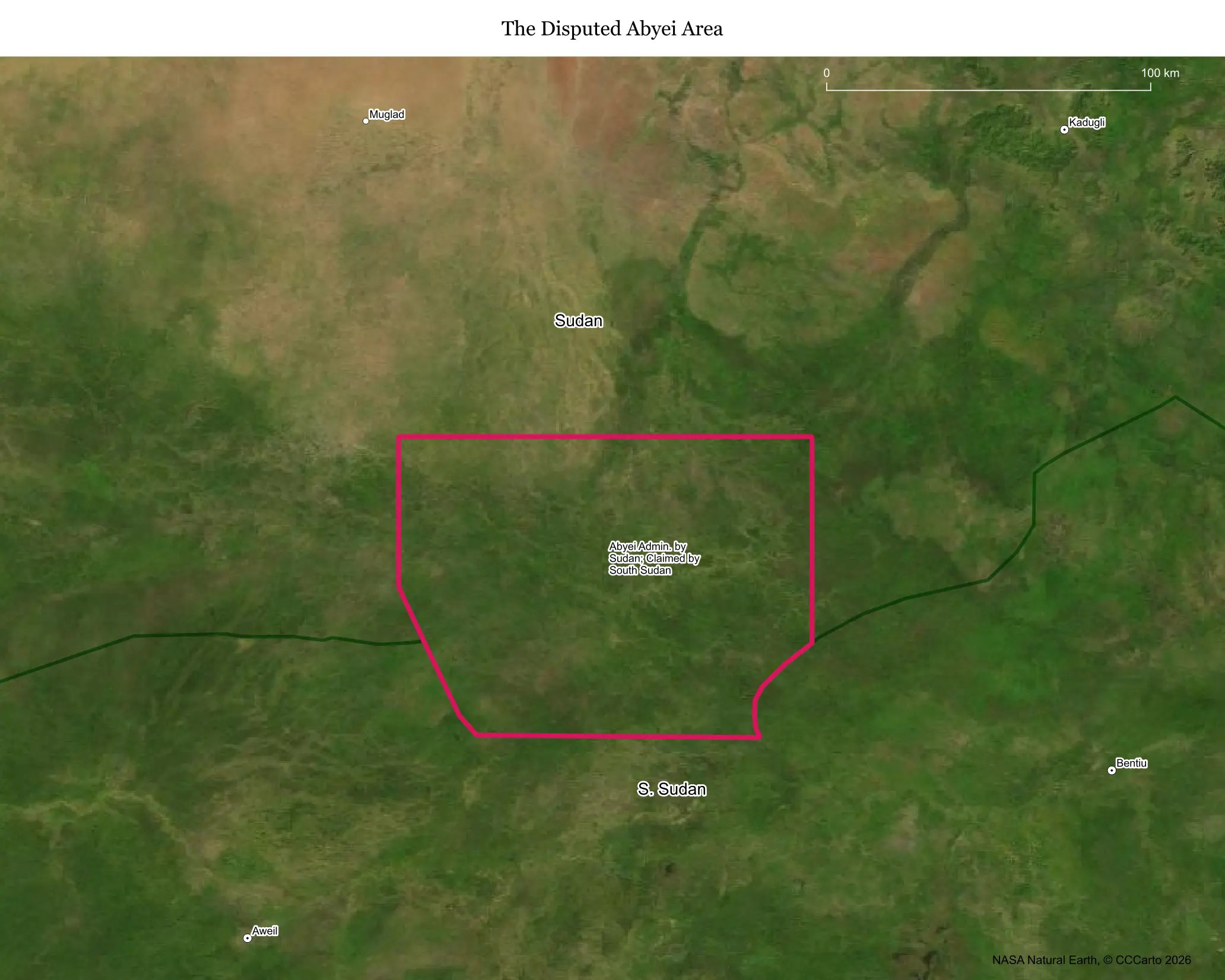
What makes this territory disputed
Abyei sits on the border between Sudan and South Sudan, and its precise boundary has never been definitively settled because a 1905 colonial-era decision left the area's status ambiguous between two different administrative lines. When South Sudan won independence in 2011 after decades of civil war, Abyei was carved out as a special interim area pending a self-determination referendum that was supposed to let residents choose which country to join.
Who is involved, and for how long
The dispute is between the governments of Sudan and South Sudan, layered on top of a long-running local rivalry between the Ngok Dinka, who consider themselves South Sudanese, and the Misseriya, Arab pastoralists aligned with Sudan. The underlying tension dates back to Sudan's civil wars from 1983 to 2005, and Abyei's unresolved status has now persisted for more than two decades without a permanent settlement.
Resources and strategic value
Abyei has oil reserves, though production has diminished significantly from earlier peaks, and its real ongoing value lies in fertile grazing land that is essential to Misseriya cattle migrations each dry season. Control over this land determines who benefits economically from any future oil activity and who governs access to grazing routes that thousands of pastoralist families depend on.
Who lives there and what's on the land today
A permanent Ngok Dinka population lives in and around Abyei town and surrounding villages, while the Misseriya arrive seasonally with large cattle herds rather than settling permanently. UN peacekeepers from UNISFA have been stationed there since 2011, and their presence is what has kept the area from escalating into open war despite periodic deadly clashes between the two communities.
Is the boundary stable?
Not fully. No referendum has ever been held despite being promised in the 2005 Comprehensive Peace Agreement, and the area remains in a kind of legal and administrative limbo, formally part of neither country. Communal clashes between Ngok Dinka and Misseriya recur periodically, particularly around grazing and cattle-raiding disputes, even though UNISFA has generally prevented these from escalating into state-level conflict.
Is a resolution coming?
There is no clear timeline. African Union-mediated talks between Khartoum and Juba have stalled repeatedly, and Sudan's own devastating civil war since 2023 has further diverted attention and capacity away from resolving Abyei's status. The referendum promised under the 2005 peace agreement remains, in practice, indefinitely postponed.
Does this dispute affect the world?
Its direct global footprint is modest, but Abyei matters as a persistent symbol of Sudan's unfinished partition and a case study in stalled UN peacekeeping mandates that has run for over 15 years. It also intersects with global oil markets in a small way and with humanitarian concerns tied to displacement and cross-border pastoralist conflict in the wider region.
Sources
- United Nations Peacekeeping: UNISFA — UN Interim Security Force for Abyei
- UN Security Council reports on Abyei: Security Council Report — Abyei
- International Crisis Group: Sudan
- CIA World Factbook: Sudan