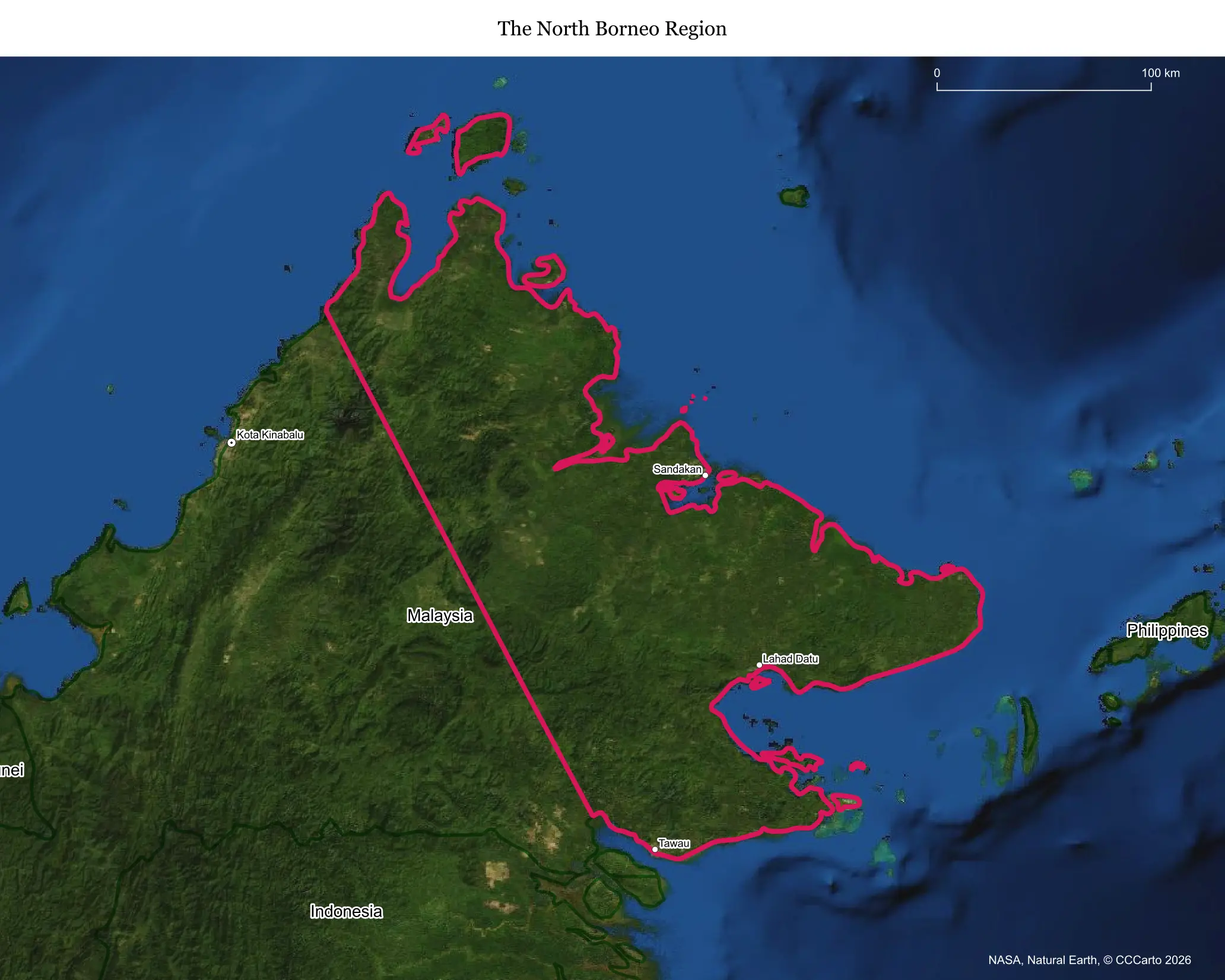
What makes this territory disputed
North Borneo, today the Malaysian state of Sabah, is claimed by the Philippines based on an 1878 agreement in which the Sultanate of Sulu, a Muslim sultanate based in what is now the southern Philippines, leased or ceded the territory to the British North Borneo Company. Whether that historic deal was a permanent cession or merely a lease remains legally disputed, and the Philippines argues it inherited the Sultanate's underlying sovereign claim.
Who is involved, and for how long
The dispute is between the Philippines and Malaysia, formally revived by the Philippine government in 1962 after decades of dormancy, shortly before Sabah joined the new Federation of Malaysia in 1963. It flared into serious violence only once in the modern era, during the February 2013 Lahad Datu standoff, when followers of a Sulu Sultanate claimant occupied a Sabah village, leading to weeks of fighting with Malaysian security forces.
Resources and strategic value
Sabah today is economically significant, with extensive palm oil plantations, timber industries, offshore oil and gas production, and some of the richest rainforest biodiversity in Southeast Asia. Those resources have developed entirely under Malaysian administration and investment over the six decades since Sabah joined Malaysia.
Who lives there and what's on the land today
Sabah has a population of roughly 3.9 million and functions as a fully developed Malaysian state with its own government, universities, industry, and infrastructure. Historically, Malaysia also paid a small annual sum, a legacy of the original 19th-century lease arrangement, to the heirs of the Sulu Sultanate, though this payment became a point of dispute and was effectively halted following the 2013 unrest.
Is the boundary stable?
Yes, overwhelmingly. Malaysia has held uncontested administrative and military control of Sabah for over six decades, and the 2013 Lahad Datu incident, while serious and deadly, was an isolated event rather than a sustained territorial contest; no Philippine government has attempted a comparable move since.
Is a resolution coming?
The claim is largely dormant at the state level, though heirs of the Sulu Sultanate pursued an international arbitration claim in the 2020s seeking billions of dollars in compensation from Malaysia, a case that has caused diplomatic friction even though it has not altered Malaysia's territorial control. The Philippine government itself rarely presses the claim actively in bilateral relations.
Does this dispute affect the world?
Its global footprint is modest, but it periodically strains Philippines-Malaysia relations and complicates security cooperation in the Sulu Sea, a region already troubled by piracy and militant activity, making joint patrols and counterterrorism coordination more politically sensitive than they might otherwise be.
Sources
- Reuters: Reuters — Asia Pacific coverage of Sabah dispute
- CIA World Factbook: Malaysia
- BBC News: Malaysia Sabah Stand-off — background