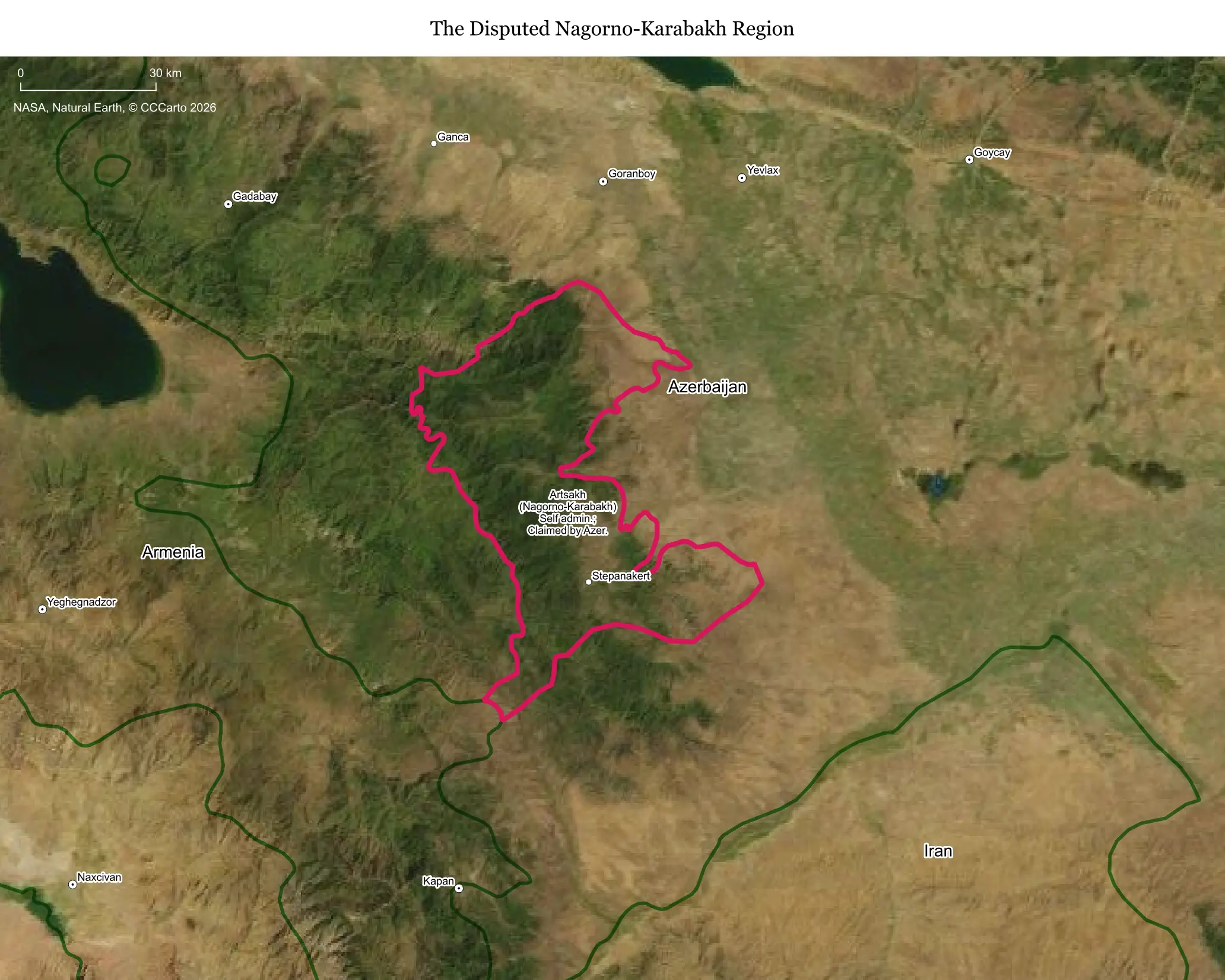
What makes this territory disputed
Nagorno-Karabakh is a mountainous enclave inside Azerbaijan's internationally recognized borders that was populated for generations mainly by ethnic Armenians. As Soviet control weakened in 1988, the region's Armenian-majority legislature voted to join Armenia, a move Azerbaijan rejected as a violation of its territorial integrity. That disagreement over sovereignty, and over which population's self-determination claim should prevail, is the root of the dispute.
Who is involved, and for how long
The conflict is between Armenia and Azerbaijan, with Karabakh's Armenian population organizing its own breakaway government, the self-declared Republic of Artsakh, from 1991 onward. Fighting has recurred across 37 years: a war from 1988 to a 1994 ceasefire that left Armenian forces in control, the 44-day Second Karabakh War in 2020 that reversed major territorial gains, and Azerbaijan's decisive September 2023 offensive that ended Armenian control entirely.
Resources and strategic value
Nagorno-Karabakh itself holds modest resources, some agriculture, forestry, and small deposits of gold and copper, but its deeper value has always been symbolic and strategic rather than economic. The wider South Caucasus corridor around it matters far more geopolitically, sitting near Caspian Sea energy pipelines and now central to a proposed transport corridor linking Azerbaijan to its Nakhchivan exclave through Armenian territory.
Who lives there and what's on the land today
Before 2023, an estimated 100,000-120,000 ethnic Armenians lived in Nagorno-Karabakh, supported by a Russian peacekeeping contingent stationed there since the 2020 war. After Azerbaijan's September 2023 offensive, nearly the entire Armenian population fled to Armenia within about a week, and Azerbaijan has since begun resettling the territory and rebuilding infrastructure under its own administration.
Is the boundary stable?
The situation on the ground is now stable and one-sided: Azerbaijan holds full military and administrative control of the territory, a sharp change from three decades of a frozen but contested front line. What remains unsettled is legal and political rather than territorial, chiefly Armenia's constitutional language and the unresolved fate of displaced Karabakh Armenians.
Is a resolution coming?
A full peace treaty text was finalized in March 2025 and publicly reaffirmed at a Washington summit that August, but it remains unsigned heading into 2026. The sticking point is Azerbaijan's demand that Armenia amend its constitution to drop any reference to Karabakh, a change Armenian Prime Minister Nikol Pashinyan says he cannot make without a referendum, tentatively linked to a vote some time in 2026.
Does this dispute affect the world?
Yes. The proposed transit corridor through southern Armenia, sometimes called the Trump Route for International Peace and Prosperity, would reroute regional trade around both Russia and Iran, altering long-standing transport dependencies in the South Caucasus. The conflict's resolution or collapse also shapes the influence of Russia, Turkey, and Iran in a region all three have historically treated as within their sphere.
Sources
- Council on Foreign Relations context via RAND — What Prospects for Lasting Peace Between Armenia and Azerbaijan?
- CACI Analyst: The Armenia-Azerbaijan Peace Process Enters 2026
- International Crisis Group: Armenia and Azerbaijan: The Hard Road to a Lasting Peace
- International Center for Transitional Justice: A Fragile Framework for Lasting Peace
- Wikipedia: 2023 Nagorno-Karabakh Ceasefire Agreement
- New Eastern Europe: For Armenia, Peace Dividends Are Finally Starting to Show Up