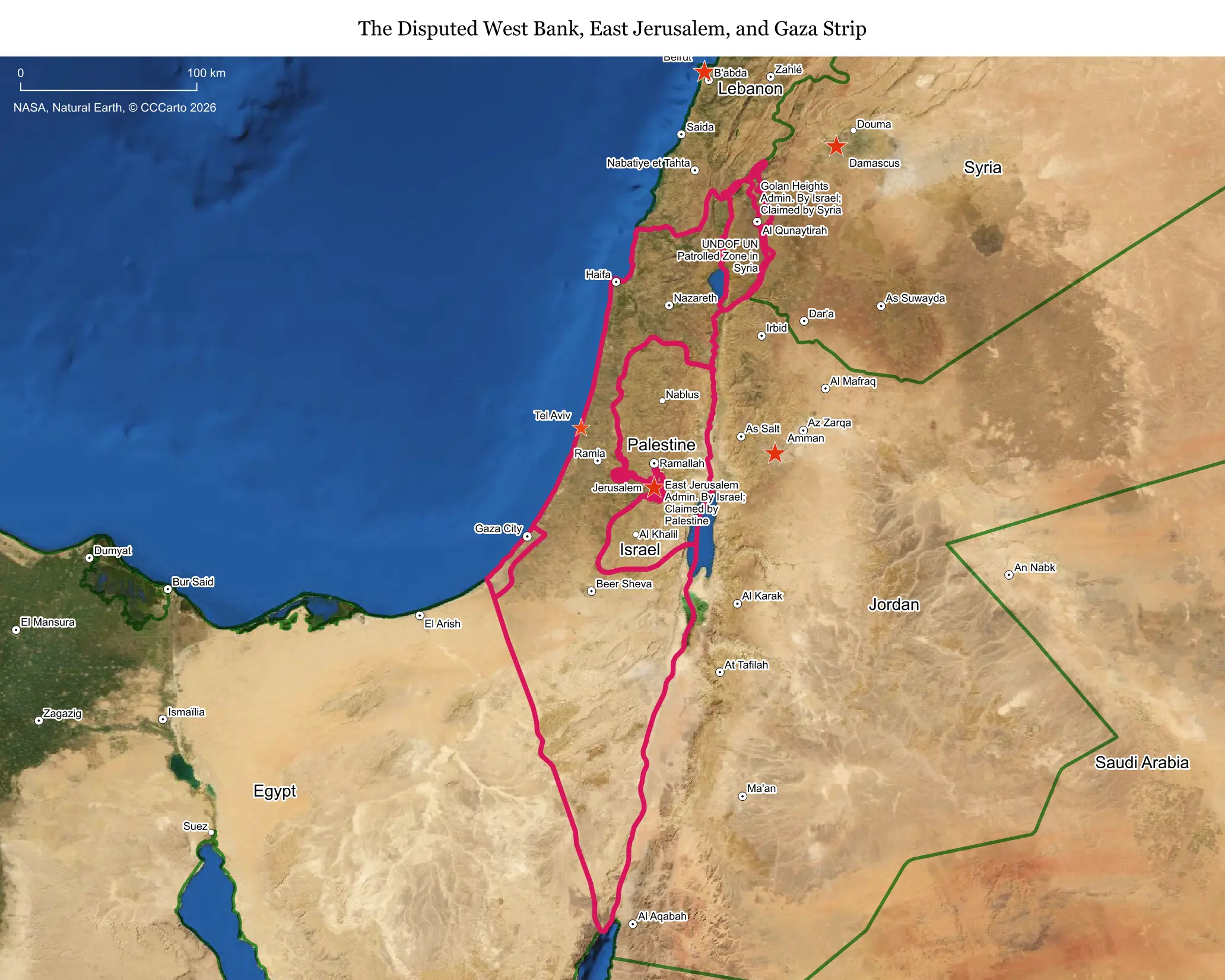
What makes this territory disputed
Israel has controlled the West Bank since capturing it from Jordan in the 1967 Six-Day War. Palestinians claim it as the heartland of a future independent state, a position backed by most of the international community and by UN resolutions calling the territory occupied. Israel disputes that characterization: many Israelis, and the Israeli government, argue the land was never part of a recognized Jordanian sovereign territory to begin with, point to the region's biblical and historical Jewish connection (it is often referred to in Israel as "Judea and Samaria"), and cite security concerns arising from its proximity to Israel's population centers. The territory's final status, whether it becomes part of a Palestinian state, is annexed by Israel, or is divided under some other arrangement, remains one of the world's most consequential unresolved territorial questions. Israeli settlement construction there, which most of the international community and the UN's top court consider a violation of international law but which Israel's government disputes on legal and historical grounds, has become one of the central flashpoints complicating any future negotiated settlement.
Who is involved, and for how long
The dispute is between Israel and the Palestinian people, represented internationally by the Palestinian Authority, and its roots trace back to the 1947 UN partition plan, which both a Jewish and an Arab state, and the 1948 war that followed the plan's rejection by Arab states and the declaration of Israeli independence. Jordan controlled the West Bank from 1948 until Israel took it in the 1967 Six-Day War, a war Israel says it fought defensively after being attacked by neighboring Arab states. Decades of on-and-off negotiations, including the 1993-95 Oslo Accords and the 2000 Camp David summit, have failed to produce a final settlement on borders, security, refugees, or the status of Jerusalem, and both sides have at various points been blamed by the other for the breakdown of talks. No substantive peace process has been underway in recent years.
Resources and strategic value
The West Bank sits atop the Mountain Aquifer, a critical shared water resource, and includes fertile agricultural land along with sites of immense religious and historical significance, including parts of Jerusalem and Hebron, that matter enormously to Jewish, Muslim, and Christian communities worldwide. Its strategic depth and high ground overlooking Israel's coastal plain also give it major security significance in Israeli strategic thinking.
Who lives there and what's on the land today
Roughly 3.3 million Palestinians live in the West Bank alongside more than 500,000 Israeli settlers. The UN and most of the international community, including a 2024 International Court of Justice advisory opinion, consider the settlements illegal under international law; Israel's government rejects this conclusion, arguing that the relevant Geneva Convention provisions do not apply to the territory and that Israelis have a legal and historical right to settle there. The territory remains divided under the unimplemented Oslo framework into Area A under Palestinian civil and security control, Area B under Palestinian civil and Israeli security control, and Area C, some 60% of the land, under full Israeli civil and security control.
Is the boundary stable?
No. Since February 2026, Israel's government has approved land-registration measures that allow land Palestinians cannot formally document ownership of to be declared state land, followed by approval of 13 new settlements in July 2026. Israeli officials have defended these steps as necessary for security, land-management, and administrative clarity in Area C, which is already under full Israeli control. Palestinian officials, rights groups, and nearly 20 governments have instead characterized the measures as de facto annexation. A UN human rights report covering the year to October 2025 documented over 36,000 Palestinians displaced and a rise in settler-related violence incidents compared with the previous year; Israeli authorities dispute aspects of how such figures are compiled and note that Palestinian attacks on Israelis, including in the West Bank, have also continued.
Is a resolution coming?
Not through any active peace process. The International Court of Justice's 2024 advisory opinion called for Israel's occupation to end "as soon as possible" and found the settlement enterprise unlawful. Israel rejected the opinion, arguing the court lacked jurisdiction and that the case reflected political rather than legal considerations; the ruling is also advisory and carries no direct enforcement mechanism. Since then, Israel has continued and expanded settlement construction, while nearly 20 countries issued a joint statement in February 2026 condemning the moves as de facto annexation. US-led initiatives, including a "Board of Peace" framework floated in early 2026, have so far produced no concrete shift in policy on the ground.
Does this dispute affect the world?
Profoundly. It remains one of the most internationally significant and polarizing conflicts on Earth, central to Middle East stability, a recurring flashpoint in global diplomacy and at the United Nations, and a driver of protests and political division across many countries. Its trajectory is also deeply intertwined with the broader Israel-Gaza war and any prospective postwar arrangements for Palestinian governance, making developments in the West Bank a bellwether for the wider regional order.
Sources
The sources below reflect a range of perspectives on the dispute, including Israeli government positions, UN and rights-group assessments, and independent policy analysis. Readers are encouraged to consult multiple sources given how contested this topic is.
- Israel Ministry of Foreign Affairs: Official positions on Judea and Samaria and the ICJ opinion
- Amnesty International: Global Impunity Fueling Israel's Unlawful Annexation Measures
- OHCHR: Israel's Settlement Expansion Drives Mass Displacement — UN Report
- Al Jazeera: Nearly 20 Countries Slam Israel's "De Facto Annexation" Drive
- Foundation for Middle East Peace: Settlement & Annexation Report, July 9, 2026
- Arab Center Washington DC: Annexation Through Law: Land Registration and Palestinian Dispossession