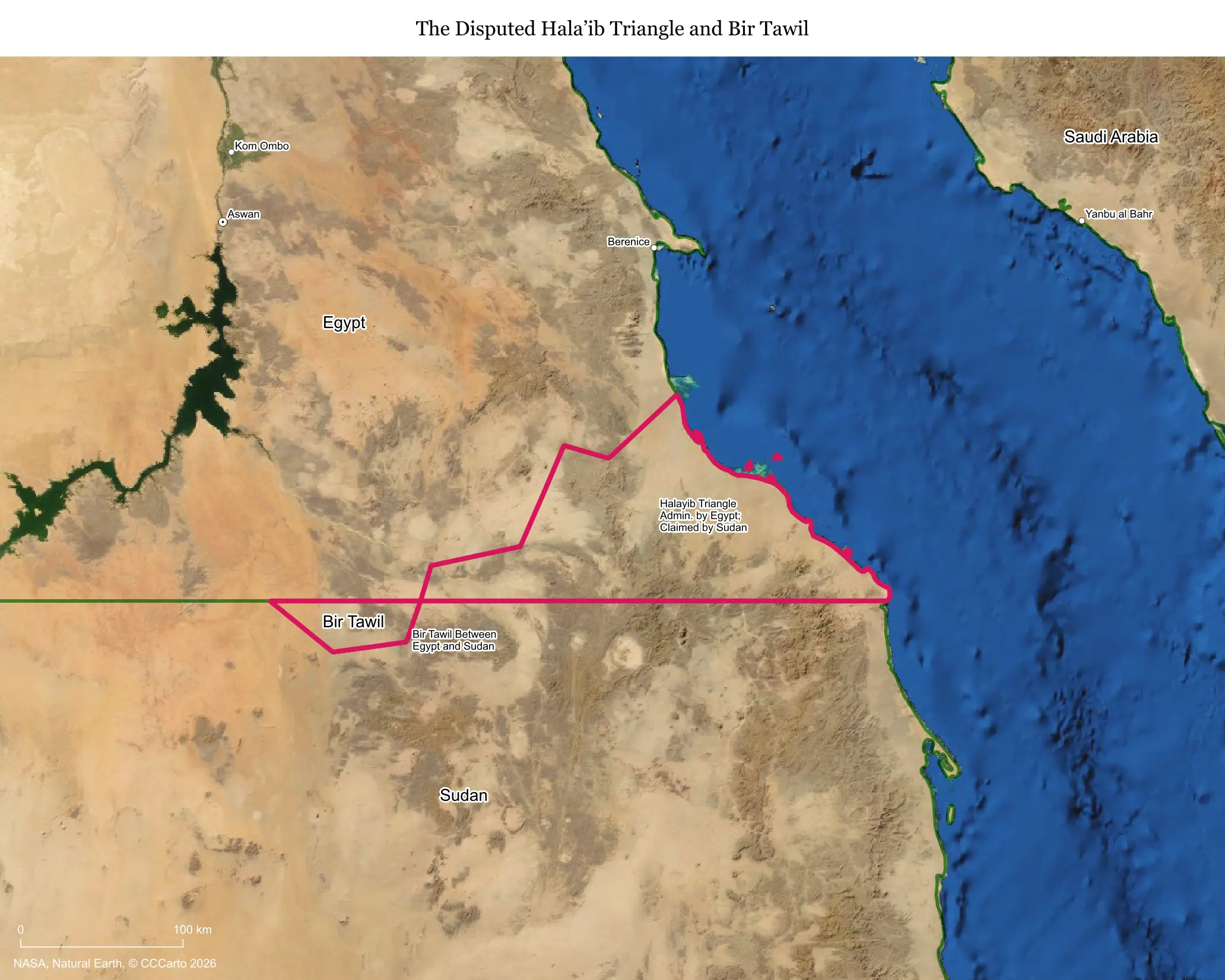
What makes this territory disputed
The Halayeb Triangle sits on the Red Sea coast where two conflicting colonial-era British boundary lines created lasting ambiguity: an 1899 political border placed the area in Egypt, while a separate 1902 administrative decision assigned it to Sudanese administration. When Sudan gained independence in 1956, both newly sovereign Egypt and Sudan claimed the territory based on these two different historical lines.
Who is involved, and for how long
The dispute is between Egypt and Sudan, and it has simmered since 1958, shortly after Sudanese independence, with periodic diplomatic flare-ups over the decades. Egypt significantly strengthened its position starting in the 1990s and effectively established full administrative and military control by the 2000s, though Sudan has never formally renounced its own claim.
Resources and strategic value
The triangle's main assets are its Red Sea coastline, useful for fishing and potential port development, and its position along one of the world's busiest shipping corridors. Some prospecting has explored possible oil and mineral deposits in the area, though it has not become a major resource-driven flashpoint compared with other disputes on this list.
Who lives there and what's on the land today
The area is sparsely populated, home to roughly 30,000 people, mostly from the Ababda and Bisharin tribes who have lived in the region for generations independent of which government claims it. Egypt has built out administrative and security infrastructure under its control, while Sudan maintains no comparable presence.
Is the boundary stable?
Largely stable in practice. Egypt has held effective, uncontested administrative control for roughly two decades, and there has been no serious military confrontation in recent years, though Sudan periodically reasserts its legal claim through diplomatic channels, including past efforts to raise the issue at the United Nations Security Council.
Is a resolution coming?
Unlikely soon. There is no active negotiation track, and Sudan's catastrophic civil war since April 2023 has left its government with little capacity or political will to press the Halayeb claim, effectively freezing the dispute in Egypt's favor for the foreseeable future.
Does this dispute affect the world?
Its direct global footprint is limited, but it remains a persistent irritant in Egypt-Sudan relations, which are already strained by the unresolved dispute over Ethiopia's Grand Ethiopian Renaissance Dam and Nile water-sharing more broadly. The area's location also touches on wider Red Sea shipping security concerns given regional instability affecting maritime traffic through the wider corridor.
Sources
- CIA World Factbook: Egypt
- CIA World Factbook: Sudan
- BBC News: Sudan coverage
- Al Jazeera: Egypt coverage