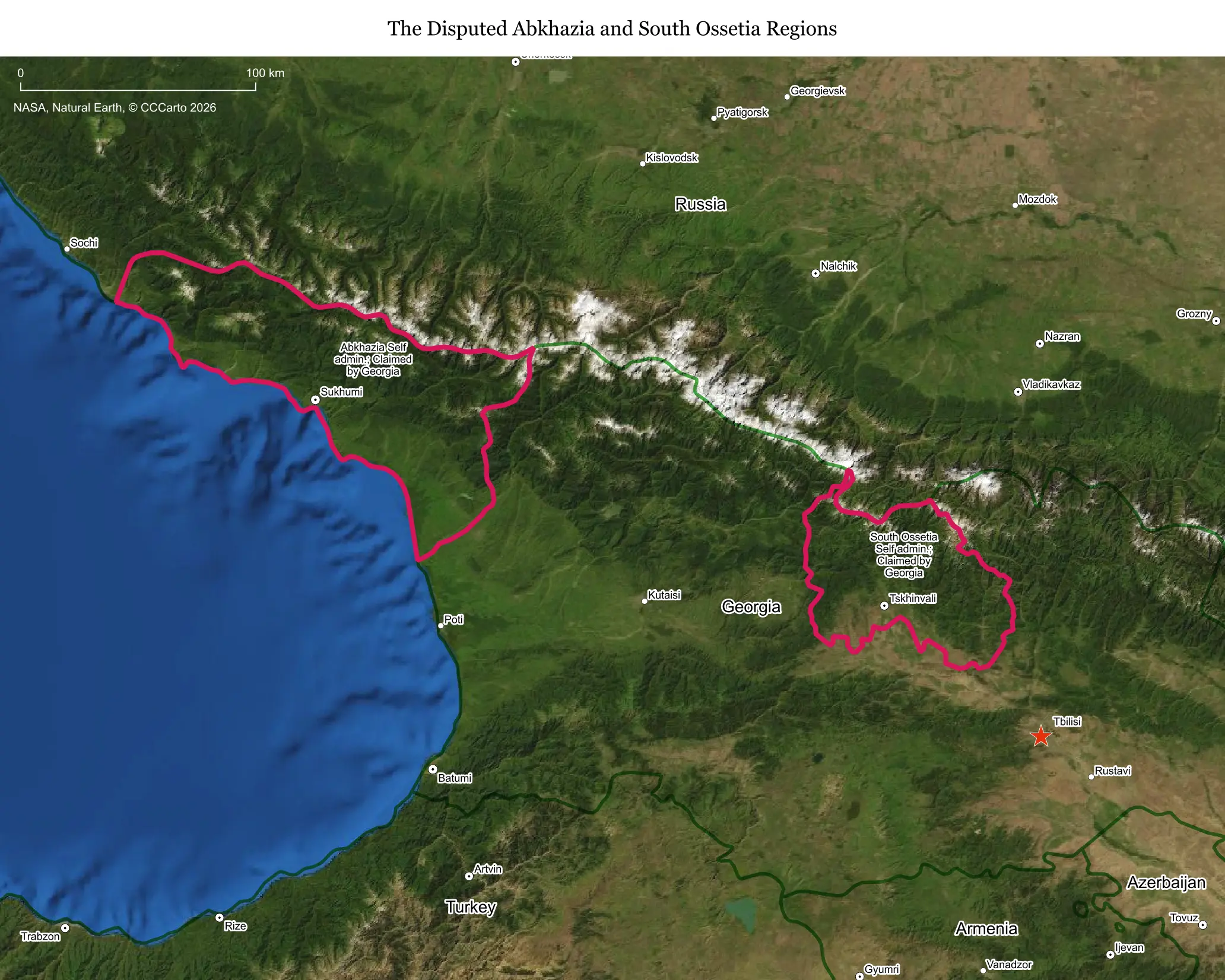
What makes this territory disputed
Abkhazia and South Ossetia are two regions of Georgia that broke away amid the chaos of the Soviet Union's collapse, each home to populations with distinct ethnic and linguistic identities from the Georgian majority and old grievances over Soviet-era autonomy. Georgia considers both integral parts of its sovereign territory under international law; Russia and the de facto local authorities consider them independent states, recognized by almost no one else.
Who is involved, and for how long
The core dispute is between Georgia and the two breakaway administrations, but Russia has been the decisive outside power since fighting first erupted in the early 1990s. The conflict escalated dramatically in August 2008, when a Russo-Georgian war over South Ossetia ended with Russian forces controlling both regions and, weeks later, formally recognizing them as independent, a stance it has held for roughly 18 years.
Resources and strategic value
Abkhazia has a Black Sea coastline with strong tourism potential, hydropower capacity, and was historically one of Georgia's most productive citrus and tea-growing regions. South Ossetia is more mountainous and resource-poor, but it sits astride the Roki Tunnel, the critical route connecting it directly to Russia and the main artery Russian forces used during the 2008 war.
Who lives there and what's on the land today
Abkhazia has roughly 245,000 residents today, down sharply from its pre-war population after most ethnic Georgians were displaced in the 1990s; South Ossetia's population is much smaller, around 50,000. Both regions depend heavily on Russian financial support, use the Russian ruble alongside local currency in South Ossetia's case, and host permanent Russian military garrisons.
Is the boundary stable?
The administrative boundary lines have been militarily stable since the 2008 ceasefire, but Georgia and rights groups regularly report Russian-backed forces moving fences and markers slightly further into Georgian-controlled territory in a process critics call 'borderization' or creeping annexation. No large-scale fighting has recurred since 2008, but the lines are not treated as fixed by either side.
Is a resolution coming?
No. Talks under the Geneva International Discussions, a format involving Georgia, Russia, the two territories, the EU, UN, and OSCE, continue periodically but have produced no breakthrough on status for over a decade. Georgia's aspirations for EU and NATO membership are complicated by the unresolved conflicts, while Russia has shown no willingness to reverse its 2008 recognition.
Does this dispute affect the world?
Yes. The regions are widely seen as a template for Russia's later actions in Ukraine, where similar patterns of recognizing breakaway territories and deploying troops followed. The dispute also blocks Georgia's Western integration, keeping a South Caucasus state that borders Russia, Turkey, and Iran in a prolonged geopolitical gray zone.
Sources
- CIA World Factbook: Georgia
- OSCE: Geneva International Discussions
- Human Rights Watch: Georgia country page
- International Crisis Group: Georgia