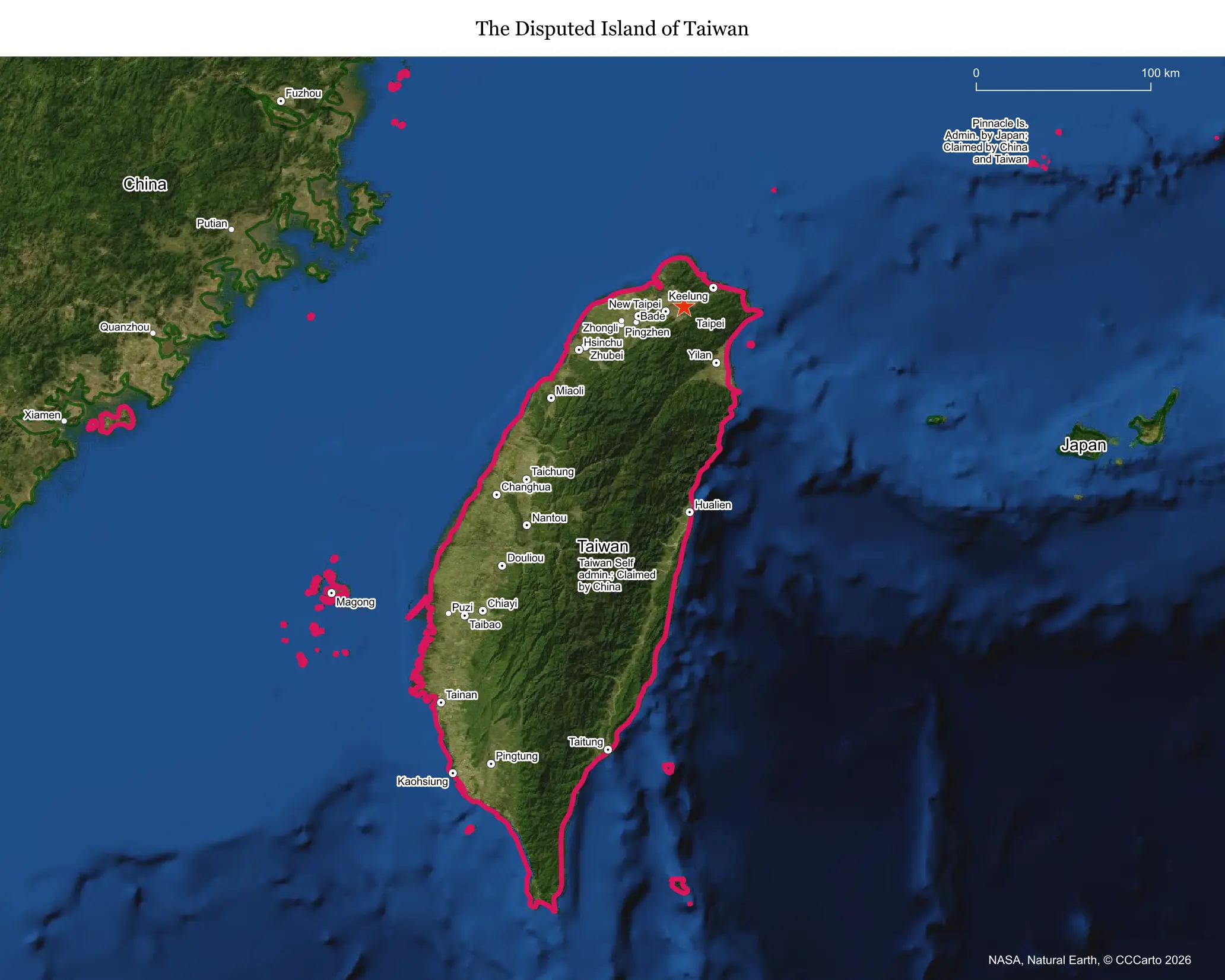
What makes this territory disputed
Taiwan has governed itself separately from mainland China since 1949, when the Nationalist government fled there after losing the Chinese Civil War to the Communists, who founded the People's Republic of China. Beijing considers Taiwan a renegade province that must eventually be reunified with the mainland, by force if necessary, while Taiwan's government and the vast majority of its population have no interest in becoming part of the People's Republic.
Who is involved, and for how long
The core dispute is between China and Taiwan, unresolved for roughly 75 years, but the United States plays an outsized third-party role through its long-standing policy of 'strategic ambiguity,' arms sales to Taiwan, and its own complex, informal relationship with the island. Tensions have escalated markedly in the 2020s, with China conducting increasingly large and frequent military exercises around Taiwan, particularly following major US arms deals or high-profile diplomatic visits.
Resources and strategic value
Taiwan's most globally significant asset is not a natural resource but an industrial one: it is home to TSMC, the world's leading manufacturer of the most advanced semiconductor chips, making the island an irreplaceable link in global technology and defense supply chains. Its location astride the so-called first island chain also gives it enormous military-strategic value for controlling access between the Western Pacific and the South and East China Seas.
Who lives there and what's on the land today
Taiwan governs about 23 million people under a robust, fully functioning democracy, complete with its own military, currency, passports, and independent foreign policy, distinguishing it sharply from more ambiguous 'disputed' territories elsewhere. It is a highly developed, technologically advanced society with its own elected president, currently Lai Ching-te, who took office in 2024.
Is the boundary stable?
Not entirely, despite no formal war since 1949. China has increasingly violated the informal median line historically dividing the Taiwan Strait since the early 2020s, and its military conducts frequent large-scale drills and incursions into Taiwan's air defense identification zone, particularly in response to US arms sales or diplomatic gestures toward Taipei, keeping the situation persistently tense rather than settled.
Is a resolution coming?
No resolution is in sight. China has not renounced the use of force and continues to increase military pressure, while Taiwan's government under President Lai has committed to defending the island's sovereignty and current status; the United States, meanwhile, continues large arms sales, including an $11.1 billion package that prompted Chinese sanctions and live-fire drills in 2026, while both Washington and Beijing try to manage the tension without derailing broader diplomatic engagement.
Does this dispute affect the world?
Enormously, and analysts widely consider it the single most dangerous potential flashpoint for a great-power war in the twenty-first century. Beyond the direct military risk to Taiwan, China, and the United States, any serious conflict or blockade would threaten the global semiconductor supply chain that modern electronics, vehicles, and defense systems depend on, with potential to trigger a worldwide economic crisis far beyond the immediate region.
Sources
- University of Washington, Henry M. Jackson School: Averting War: Taiwan and US-China Relations in 2026
- American Enterprise Institute: China & Taiwan Update, June 12, 2026
- South China Morning Post: Can Beijing and Washington Shield Their Planned State Visits From Taiwan Tensions?
- Council on Foreign Relations: Tensions in the Taiwan Strait — Global Conflict Tracker