Venezuela Oil Production & Exports (2023–2026) — Live Invasion Impact Update
Last updated: January 3, 2026 (Pacific Time). This page tracks Venezuela’s recent crude output/exports and how the current U.S. military operation and instability risk can affect oil sales, shipping, and global prices.
What the oil market is watching right now
-
Facilities vs. exports: Reuters sources said PDVSA production and refining were operating normally and suffered no damage from the January 3 strike, but exports were already constrained by shipping enforcement and tanker risk.
-
December choke point: Reuters reported a U.S. “blockade”/interdictions and seizures in December that cut exports to about half of November levels, with vessel owners diverting away from Venezuelan waters and PDVSA building inventories.
-
Unrest risk (and misinformation): Early Reuters reporting described streets as largely calm at daybreak with limited gatherings, while other reporting noted a surge of misleading/AI-generated visuals on social platforms after the capture announcement.
-
Global price impact is scenario-driven: Venezuela’s volume is modest in global terms, but its heavy crude matters to specific refineries. The biggest near-term mover is whether exports face further interruption (ports, crews, insurance, sanctions enforcement), not geology.
Production & Exports Snapshot
| Year / period |
Avg daily crude production |
Exports (avg) |
Notes relevant to trade |
| 2023 |
~0.78 mb/d (OPEC-reported via Reuters) |
~0.70 mb/d (≈695 kb/d avg exports) |
Exports rose with U.S. sanctions easing; China took ~65% of exports; U.S. ~19% (~135 kb/d); Europe ~4%; Cuba ~8% (per Reuters/LSEG vessel data).
|
| 2024 |
~0.95 mb/d (PDVSA results cited by Reuters) |
~0.81 mb/d (≈805.5 kb/d avg exports) |
PDVSA foreign oil sales reported at ~$17.5B; exports up >15% vs 2023 (Reuters review of PDVSA results + tracking/documents).
|
| 2025 (selected indicators) |
~0.85–1.00+ mb/d (range; month-to-month) |
Nov: ~952 kb/d (3rd-highest month)
Dec: exports fell sharply after seizure/enforcement (see notes)
|
Reuters reported exports fell sharply after a U.S. tanker seizure (Dec 2025), with ~11M barrels stuck in vessels and only some Chevron-chartered cargoes sailing out.
|
| 2026 (Jan 3) — live operation |
Operating normally (Reuters sources) |
Still constrained by tanker/insurance/sanctions enforcement |
Reuters sources said oil production/refining suffered no damage from the strike; Reuters also reported December enforcement cut exports to about half of November and pushed PDVSA toward slower loadings/floating storage.
|
Note on ranges: Venezuela’s “direct” communications, OPEC secondary sources, and tanker tracking can diverge. Where possible, figures here follow Reuters reporting that cites PDVSA documents, OPEC-reported numbers, and vessel-monitoring data.
Will street unrest / “riots” affect oil trade?
It can—but the mechanism matters. In the near term, Venezuela’s oil trade is already being influenced by shipping enforcement risk (interdictions, sanctions, vessel owners avoiding Venezuelan waters) and by PDVSA logistics constraints (slower loadings, inventories).
Large-scale unrest becomes oil-relevant if it spills into any of the following:
- Port access & staffing: terminal labor shortages, strikes, blocked roads, or security lockdowns delay loadings and raise demurrage.
- Security incidents/sabotage: damage to power supply, pipelines, storage tanks, pumping stations, or refinery utilities causes sudden shut-ins.
- Insurance & chartering: war-risk premiums spike; crews/owners refuse calls; fewer “clean” tankers available—exports fall even if crude is produced.
- Payment & contracting: buyers demand deeper discounts, looser terms, or contract changes (reported by Reuters in late-2025 after tanker seizures).
How this can affect world oil prices & trade flows
-
Headline risk adds a “risk premium,” but exports drive the real price move.
If exports continue to be constrained (or worsen), the market tightens; if export corridors reopen quickly, price spikes often fade.
-
Heavy crude matters disproportionately.
Venezuela’s barrels are often heavy/sour; when those disappear, specific refineries (especially heavy-crude systems) must bid up alternative grades, widening differentials.
-
Trade rerouting & discounts.
When enforcement risk rises, cargoes reroute through intermediaries, paperwork “cover” changes, and discounts widen (Reuters reporting from Dec 2025 describes customers pressing PDVSA for steeper discounts/contract changes).
-
OPEC+ reaction function.
Reuters noted OPEC+ meets Jan 4, 2026 to discuss output. If Venezuela exports drop materially, other producers could offset—if they choose.
Short-term “watch list” (next 72 hours)
- Port status at Jose/Amuay/Cardón and any PDVSA loading delays or force majeure notices
- War-risk insurance changes / tanker availability for Venezuela-lifting routes
- Any U.S. Treasury / sanctions guidance that changes who can legally lift or insure cargoes
- OPEC+ meeting signals on whether offsetting supply will be added or withheld
Disclaimer: This is an informational summary based on publicly available reporting and does not constitute investment advice.
Rapidly developing events can change conditions quickly; treat early videos/images with caution and prefer verified reporting.
1. Current Oil Drilling Services & Companies(Pre-invasion)
-
Valesco – Company of mixed Venezuelan capital offering comprehensive oil field services including
perforación (drilling), rehabilitación y acondicionamiento de pozos, tubería continua,
taladros (drill rigs), and directional drilling services for oil & gas wells.
-
CPVEN (Maritime – MCVSA) – Provides drilling and well rehabilitation services with high-capacity
drill barges (up to ~2000 HP) for oil & gas wells in Lake Maracaibo and other regions.
-
Global Energy, CA – Operates land drilling and workover rigs in Venezuela, with fleets designed to
support drilling, repair and optimization of oil wells.
2. Oil & Gas Equipment Providers and Suppliers(Pre-invasion)
-
SIPPPCO, S.A. – Venezuelan engineering and equipment company supplying and fabricating drilling tools,
well parts and accessories for drilling and maintenance operations in the oil industry.
-
Petroccidente, S.A. – Supplier of key products for the oil & gas sector including drilling pipes, casings,
drilling wire (guayas), and specialized chemicals for drilling, production and maintenance.
-
Midland Oil Tools & Services (MOT&S – Venezuela) – Offers products and rentals for drilling and well
completion including tools for tubular handling, casing, drill-pipe, mud pump parts, valves, and other oilfield equipment.
-
IPF, C.A. – Provides drilling equipment, well maintenance services and technology for optimizing
drilling and production operations.
3. Additional Oil & Gas Equipment Types (Examples & Product Categories)
- Tubing & casing for drilling and production (e.g., drill pipe, heavy-weight drill pipe, pup joints, crossover tools) —
offered by local suppliers like FullPetro (product categories).
- Well completion accessories — packers, float collars, centralizers and other completion tools for oil & gas wells.
- Chemical additives and specialized fluids — inhibitors, demulsifiers, corrosion control for drilling & production.
4. Industry Context (Sanctions & Operations)
Venezuela’s oil and gas sector has historically been dominated by PDVSA, the state-owned oil company.
Recent geopolitical context has influenced foreign participation: U.S. sanctions and licenses affect which foreign
companies can operate or supply services. For example, Shell had plans for offshore gas development under U.S.
licensing conditions into 2026.
Linked sources
- Reuters (Jan 3, 2026) — “Venezuela’s oil facilities unscathed in US strike, sources say”
- Reuters (Jan 3, 2026) — “Trump says Venezuela’s Maduro captured after strikes”
- Reuters (Jan 3, 2026) — “Investors and economists react to US capture of Venezuela’s Maduro”
- Reuters (Dec 31, 2025) — “US issues fresh sanctions targeting Venezuela’s oil sector”
- Reuters (Dec 12, 2025) — “Venezuela oil exports fall sharply after US tanker seizure…”
- Reuters (Dec 16, 2025) — “Venezuela faces demands for big oil discounts and contract changes…”
- Reuters (Dec 30, 2025) — “Oil tankers still arriving in Venezuela despite US blockade, data shows”
- Reuters (Jul 11, 2025) — “PDVSA oil sales abroad hit $17.5B in 2024 as exports jump”
- Reuters (Jan 3, 2024) — “Venezuela’s 2023 oil exports rose, aided by US sanctions easing”
- Axios (Jan 3, 2026) — “World leaders denounce U.S. operation to capture Maduro”
- WIRED (Jan 3, 2026) — “Disinformation Floods Social Media After Nicolás Maduro’s Capture”
Field Acronyms
EUR_MMBOE = Estimated ultimate recovery in million barrels of oil equivalent
Giant oil and gas fields = those with 500 million barrels (79,000,000 m3) of ultimately recoverable oil or gas equivalent.
Super giant oil field = holds equivalent of 5.5bn barrels of oil reserves.
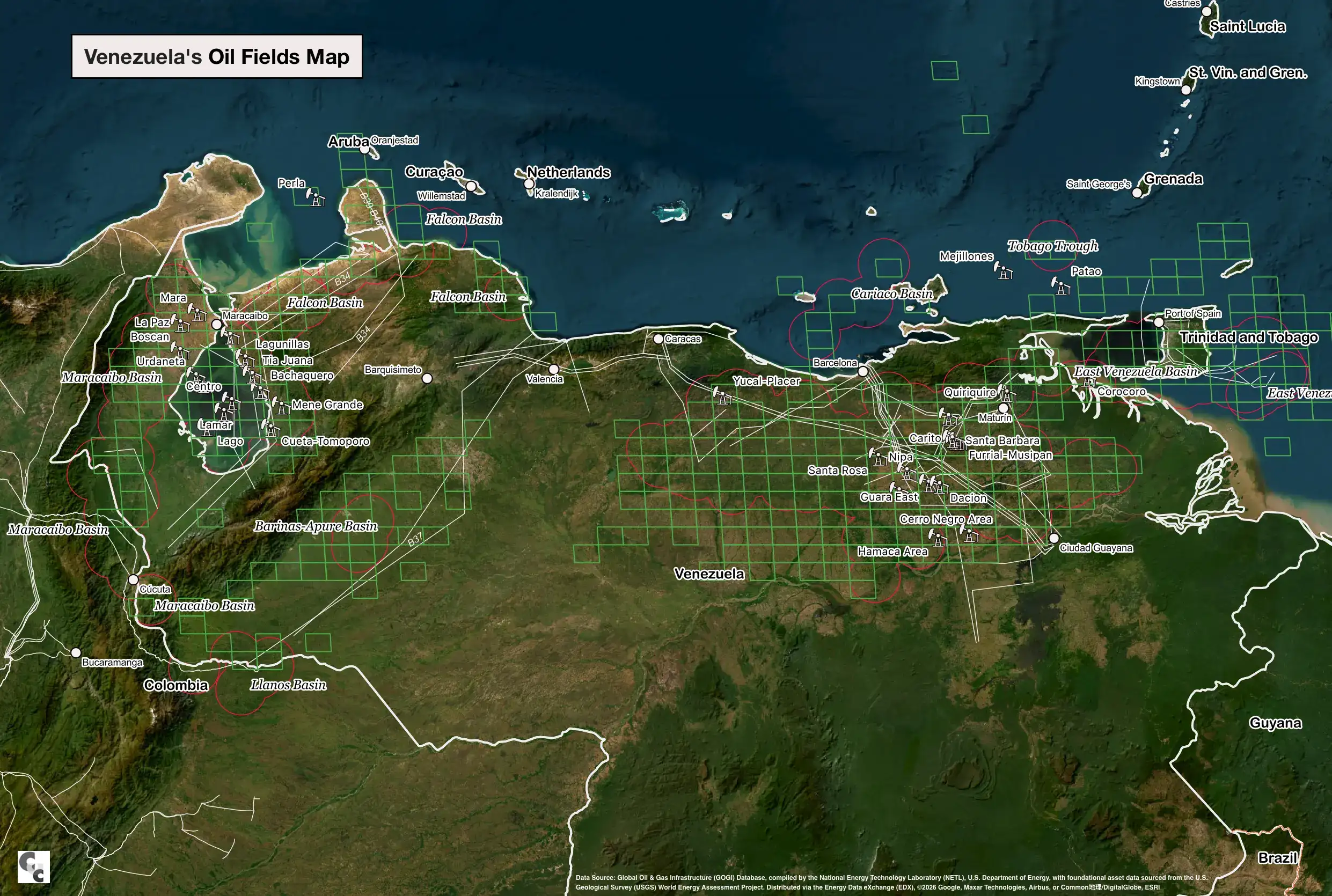
Venezuela Oil Fields
Bachaquero Field, Venezuela, Discovered 1930, Supergiant Field
Boscan Field, Venezuela, Discovered 1946, Giant Field
Cabinas Field, Venezuela, Discovered 1917, Giant Field
Carito Field, Venezuela, Discovered 1988, Supergiant Field
Centro Field, Venezuela, Discovered 1957, Giant Field
Cerro Negro Area Field, Venezuela, Discovered 1939, Giant Field
Corocoro Field, Venezuela, Discovered 1999, Giant Field
Cueta-Tomoporo Field, Venezuela, Discovered 2002, Giant Field
Dacion Field, Venezuela, Discovered 1945, Giant Field
Furrial-Musipan Field, Venezuela, Discovered 1986, Giant Field
Guara East Field, Venezuela, Discovered 1942, Giant Field
Hamaca Area Field, Venezuela, Discovered 1936, Supergiant Field
La Paz Field, Venezuela, Discovered 1925, Giant Field
Lago Field, Venezuela, Discovered 1958, Giant Field
Lagunillas Field, Venezuela, Discovered 1926, Supergiant Field
Lama Field, Venezuela, Discovered 1957, Giant Field
Lamar Field, Venezuela, Discovered 1957, Giant Field
Mara Field, Venezuela, Discovered 1945, Giant Field
Mata Field, Venezuela, Discovered 1954, Giant Field
Mejillones Field, Venezuela, Discovered 1980, Giant Field
Mene Grande Field, Venezuela, Discovered 1914, Giant Field
Nipa Field, Venezuela, Discovered 1945, Giant Field
Oficina Field, Venezuela, Discovered 1937, Giant Field
Patao Field, Venezuela, Discovered 1979, Giant Field
Perla Field, Venezuela, Discovered 2009, Giant Field
Quiriquire Field, Venezuela, Discovered 1925, Giant Field
Santa Barbara Field, Venezuela, Discovered 1941, Giant Field
Santa Rosa Field, Venezuela, Discovered 1941, Giant Field
Tia Juana Field, Venezuela, Discovered 1928, Supergiant Field
Urdaneta Field, Venezuela, Discovered 1955, Giant Field
Yucal-Placer Field, Venezuela, Discovered 1948, Giant Field
Data Source: Dr. M. K. (Mike) Horn/AAPG Datapages compilation
Return to Map Index
Copyright CCCarto 2026