Oil Field Maps
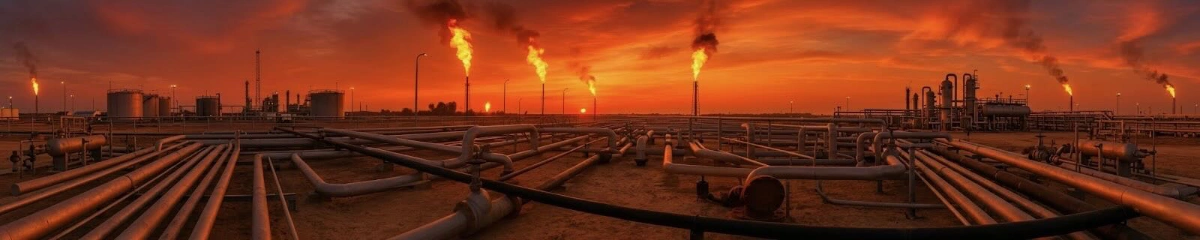
Iraq Oil Fields Map
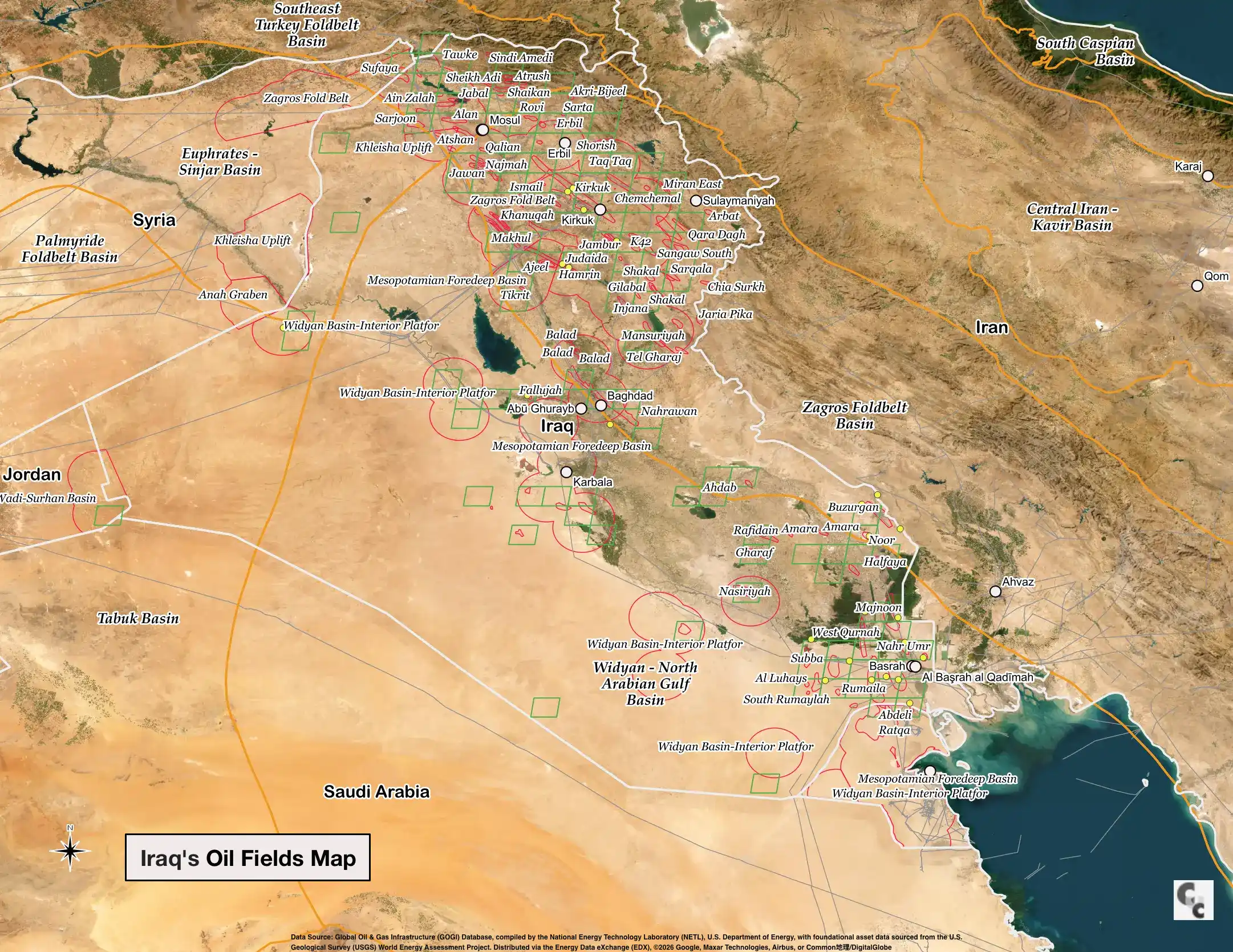
Iraq Oil Basins and Fields Map
Iraq has a rich history in oil production, dating back to the early 20th century when it became a significant player in the global oil market. The country's oil fields are predominantly located in the southern and northern regions, with major fields contributing substantially to its economy and global oil supply.
Before the Gulf War in the early 1990s, Iraq boasted a considerable number of active oil fields and derricks. However, the impact of wars, sanctions, and internal conflicts over the decades has significantly affected the infrastructure and production capabilities of these fields. Around 40 years ago, Iraq had numerous active oil fields and derricks spread across its territory, supporting its position as a key global oil producer.
Today, Iraq still maintains several active oil fields, albeit with varying levels of production efficiency and security challenges. The number of operational oil fields has fluctuated due to ongoing geopolitical instability and technical challenges in maintaining and expanding production capacities. Despite efforts to revive and modernize the oil sector, Iraq faces infrastructure constraints and political hurdles that have hindered its ability to maximize production potential.
As for the future of Iraq's oil reserves, estimates suggest that the country holds substantial remaining reserves, particularly in its largest fields. However, projections on when Iraq's oil reserves will be fully exploited or depleted depend on factors such as technological advancements, investment in infrastructure, geopolitical stability, and global oil demand trends.
Among Iraq's largest oil and gas fields, several stand out in terms of size and production capacity:
1. Rumaila Oil Field: Located in southern Iraq, Rumaila is one of the largest oil fields in the world. It spans over 1,800 square kilometers and has been a major contributor to Iraq's oil output.
2. West Qurna Field: Another significant field in southern Iraq, West Qurna is known for its vast reserves and substantial production capacity. It covers an area of about 1,200 square kilometers.
3. Majnoon Oil Field: Situated in the southern marshlands, Majnoon is one of Iraq's largest oil fields in terms of reserves. It has faced development challenges but remains crucial to Iraq's oil strategy.
4. Kirkuk Oil Field: Located in northern Iraq near the city of Kirkuk, this field has historically been a major producer. Its production has been affected by political disputes and security concerns.
5. Zubair Oil Field: Also in southern Iraq, Zubair is known for its significant reserves and has been developed through international partnerships.
These fields continue to play a pivotal role in Iraq's oil industry, albeit with varying levels of operational efficiency and output due to internal and external challenges. The development and management of these fields are critical to Iraq's economic stability and its position in the global energy market.
What Happened After the 2003 Iraq War
Following the 2003 US-led invasion under George W. Bush, Iraq's oil industry essentially collapsed. Years of prior international sanctions had already left the infrastructure decaying, and the war brought direct structural damage, widespread looting, and a complete dismantling of the Ba'athist government's management framework. In the immediate post-war years, production plummeted, and sectarian violence frequently targeted pipelines and export facilities, stalling recovery efforts and forcing a total restructuring of the industry.
Is Production Back to Pre-War Levels?
Yes, though 2026 has introduced unprecedented volatility. Before the 2003 invasion, Iraq produced roughly 2.5 to 2.8 million barrels per day (bpd). By January 2026, production had surged to over 4.1 million bpd, comfortably exceeding pre-war levels.
However, as of March and April 2026, the US-Israeli war with Iran and subsequent attacks in the Persian Gulf effectively shut down the Strait of Hormuz. Because Iraq lost its primary shipping route and rapidly ran out of storage, production was aggressively slashed to around 1.6 million bpd. The country is currently scrambling to reroute flows through the Kirkuk-Ceyhan pipeline in Turkey to stabilize output.
Who Runs the Oil Industry?
The industry is primarily state-run but relies heavily on international partnerships. The federal Ministry of Oil (MOO) in Baghdad manages the vast majority of the country's crude through state-owned entities, the largest being the Basrah Oil Company. To boost production, Baghdad brought in major International Oil Companies (IOCs) using Technical Service Contracts (TSCs). Under these contracts, foreign companies are paid a flat fee per barrel produced, ensuring Iraq retains full ownership of the oil.
In the north, the semi-autonomous Kurdistan Regional Government (KRG) manages its own oil operations, which has historically been a source of legal and political friction with Baghdad.
Is Iraq's Government Stable?
Compared to the turbulent 2000s and 2010s, Iraq is currently experiencing a strong period of political cohesion. The government under Prime Minister Mohammed Shia' al-Sudani has largely avoided the political paralysis and deadlocks of previous years. The ruling coalition has successfully passed budgets, advanced policies, and attracted foreign investment. Major protests have been limited, and security has vastly improved, with no significant resurgence of the Islamic State. While corruption and over-reliance on hydrocarbons remain challenges, the government itself is the most stable it has been in years.
Will Sales Stabilize to Help Rebuild, and Who is Buying?
Oil remains the foundation of Iraq's rebuilding efforts, historically accounting for over 90% of government revenue. Before the 2026 Strait of Hormuz crisis, stable oil revenues were successfully funding infrastructure investments and driving down poverty. The current geopolitical crisis has severely disrupted these sales, forcing Iraq to desperately expand trucking routes and northern pipeline capacity to maintain the revenues required to keep rebuilding the country.
When it comes to buyers, Iraq's oil flows predominantly East. China and India are by far the two largest recipients, accounting for nearly two-thirds of Iraq's crude exports (averaging over 3.3 million bpd in 2025). Europe is the next largest market, taking in roughly 560,000 bpd.
Sources
- Shafaq News (April 2026): "Iraq produces 302 million bpd in Q1 2026" — Provided data on the production drop from 4.15 million bpd to 1.62 million bpd due to Gulf shipping disruptions.
- Türkiye Today / Market Reports (May 2026): "Iraq to triple Ceyhan oil exports to 770,000 bpd amid Hormuz crisis" — Outlined Iraq's 89% drop in southern exports and the strategic pivot to Turkish pipelines and trucking.
- BTI Transformation Index (2026): "Iraq Country Report" — Assessment of Prime Minister Mohammed Shia' al-Sudani's government stability, improved security conditions, and budget cohesion.
- Reuters / BOE Report (March 2026): "Iraq reduces oil output... if Hormuz disruptions persist" — Covered the forced production cuts due to critical storage limits and identified China and India as the top buyers of Iraqi crude.
Field Acronyms
EUR_MMBOE = Estimated ultimate recovery in million barrels of oil equivalent
Giant oil and gas fields = those with 500 million barrels (79,000,000 m3) of ultimately recoverable oil or gas equivalent.
Super giant oil field = holds equivalent of 5.5bn barrels of oil reserves.
Oil Field Key
- EUR_MMBOE: Estimated Ultimate Recovery in million barrels of oil equivalent (MMBOE).
- RSVS_MMBOE: Reserves in million barrels of oil equivalent (MMBOE).
- EURO_MMBO: Estimated Ultimate Recovery of oil in million barrels of oil (MMBO).
- EURG_TCFG: Estimated Ultimate Recovery of gas in trillion cubic feet of gas (TCFG).
- EURC_MMBO: Estimated Ultimate Recovery of condensate in million barrels of oil (MMBO).
- HL10_MMBOE: Hydrocarbon recovery estimate at a 10% decline rate in million barrels of oil equivalent (MMBOE).
- HL20_MMBOE: Hydrocarbon recovery estimate at a 20% decline rate in million barrels of oil equivalent (MMBOE).
- HL50_MMBOE: Hydrocarbon recovery estimate at a 50% decline rate in million barrels of oil equivalent (MMBOE).
- PRV_USGS_C: Proven reserves or production estimate from the U.S. Geological Survey (USGS).
- PRV_USGS_N: Name of the basin or area of interest identified by the USGS (e.g., San Juan Basin).
- BSN_TELL_C: Basin classification code (e.g., BS000000715).
- BSN_TELL_N: Basin name (e.g., San Juan Basin).
- BSN_BALLY: Basin type classification (e.g., Type 2).
- RSVR_NAME: Reservoir name (e.g., Barnett).
- RSVR_LITH1: Reservoir lithology or rock type (e.g., Shale).
- RSVR_LITH2: Secondary reservoir lithology (e.g., fractured shale).
- ERA: Geological era (e.g., Mesozoic).
- SYSTEM: Geological system (e.g., Cretaceous).
- SERIES: Geological series (e.g., Upper Cretaceous).
- STAGE: Geological stage (e.g., Primary Oil migration).
- AGE_CODE: Geological age code (e.g., MZ_CT_U: Mesozoic, Cretaceous, Upper).
- RSVR_DEPFT: Reservoir depth in feet (e.g., 6065 feet).
- RSVR_DEPKM: Reservoir depth in kilometers (e.g., 1.85 km).
- TRAP_CLASS: Trap classification (e.g., Stratigraphic).
- TRAP_TYPE: Trap type (e.g., Pinch-out).
- TRAP_DESC: Trap description (e.g., Porosity wedge, stratigraphic).
Iraq Oil Fields
Abu Ghirab Field, Discovered 1971, Giant
Ahdab Field, Discovered 1979, Giant
Ajil Field, Discovered 1978, Giant
Akkas Field, Discovered 1992, Giant
Baghdad Field, Discovered 1958, Giant
Baghdad Field, Discovered 1979, Supergiant
Bai Hassan Field, Discovered 1953, Giant
Buzurgan Field, Discovered 1970, Giant
Gharraf Field, Discovered 1979, Giant
Halfayah Field, Discovered 1976, Giant
Hamrin Field, Discovered 1961, Giant
Jabal Fauqui Field, Discovered 1974, Giant
Jambur Field, Discovered 1954, Giant
Khabbaz Field, Discovered 1985, Giant
Kirkuk Field, Discovered 1927, Supergiant
Luhais Field, Discovered 1961, Giant
Majnoon Field, Discovered 1977, Supergiant
Mansuriyah Field, Discovered 1978, Giant
Miran West 1 Field, Discovered 2009, Giant
Missan Field, Discovered 1982, Giant
Nahr Umr Field, Discovered 1948, Supergiant
Nasiryah Field, Discovered 1978, Giant
Noor Field, Discovered 1977, Giant
Rachi Field, Discovered 1957, Giant
Rafidain Field, Discovered 1984, Giant
Ratawi Field, Discovered 1950, Giant
Rumaila North and South Field, Discovered 1953, Supergiant
Safwan Field, Discovered 1977, Giant
Shaikan 1 Field, Discovered 2009, Giant
Subba Field, Discovered 1989, Giant
Taq Taq (Kurdistan) Field, Discovered 2009, Supergiant
Tuba Field, Discovered 1959, Giant
West Qurna Field, Discovered 1973, Supergiant
Zubair Field, Discovered 1949, Supergiant
Data Source: EIA/MARTIN
Return to Map Index
Copyright CCCarto 2026