Origins of Saudi Arabia’s Oil Industry
Saudi Arabia’s oil and gas industry began taking shape in the 1930s when large-scale exploration accelerated.
Commercial oil was first discovered in 1938 at Dammam Well No. 7, establishing the foundation of the modern Saudi petroleum sector.
The true turning point came with the discovery of the
Ghawar Field in 1948, widely recognized as the largest conventional oil field ever found.
Ghawar stretches roughly 170 miles (280 km) and has produced well over 65–70 billion barrels of oil.
At peak output, the field alone supplied more than 5 million barrels per day (bpd), helping establish Saudi Arabia as a global oil superpower.
Major Oil Fields and Production Capacity
Saudi Arabia operates several massive oil fields that underpin its global production leadership:
- Safaniya Field — The world’s largest offshore oil field, with capacity around 1.3 million bpd.
- Shaybah Field — A remote Rub’ al Khali desert field producing ~1 million bpd of high-quality crude.
- Khurais Field — Expanded in the late 2000s, now producing roughly 1.2–1.5 million bpd.
- Other major contributors include Abqaiq, Zuluf, and Marjan.
Saudi Arabia’s total sustainable crude oil production capacity is generally estimated at around
12 million barrels per day, with the ability to increase output during supply disruptions.
Saudi Aramco and Operational Scale
At the center of the Kingdom’s petroleum dominance is Saudi Aramco, the state-owned energy company and one of the most valuable firms globally.
The company controls:
- ~260–270 billion barrels of proven oil reserves
- 300+ trillion cubic feet (Tcf) of natural gas reserves
- The world’s largest integrated oil production infrastructure
Saudi Aramco manages extensive upstream, midstream, and downstream operations, including pipelines, refineries,
petrochemical complexes, and export terminals such as Ras Tanura, the largest offshore oil loading facility in the world.
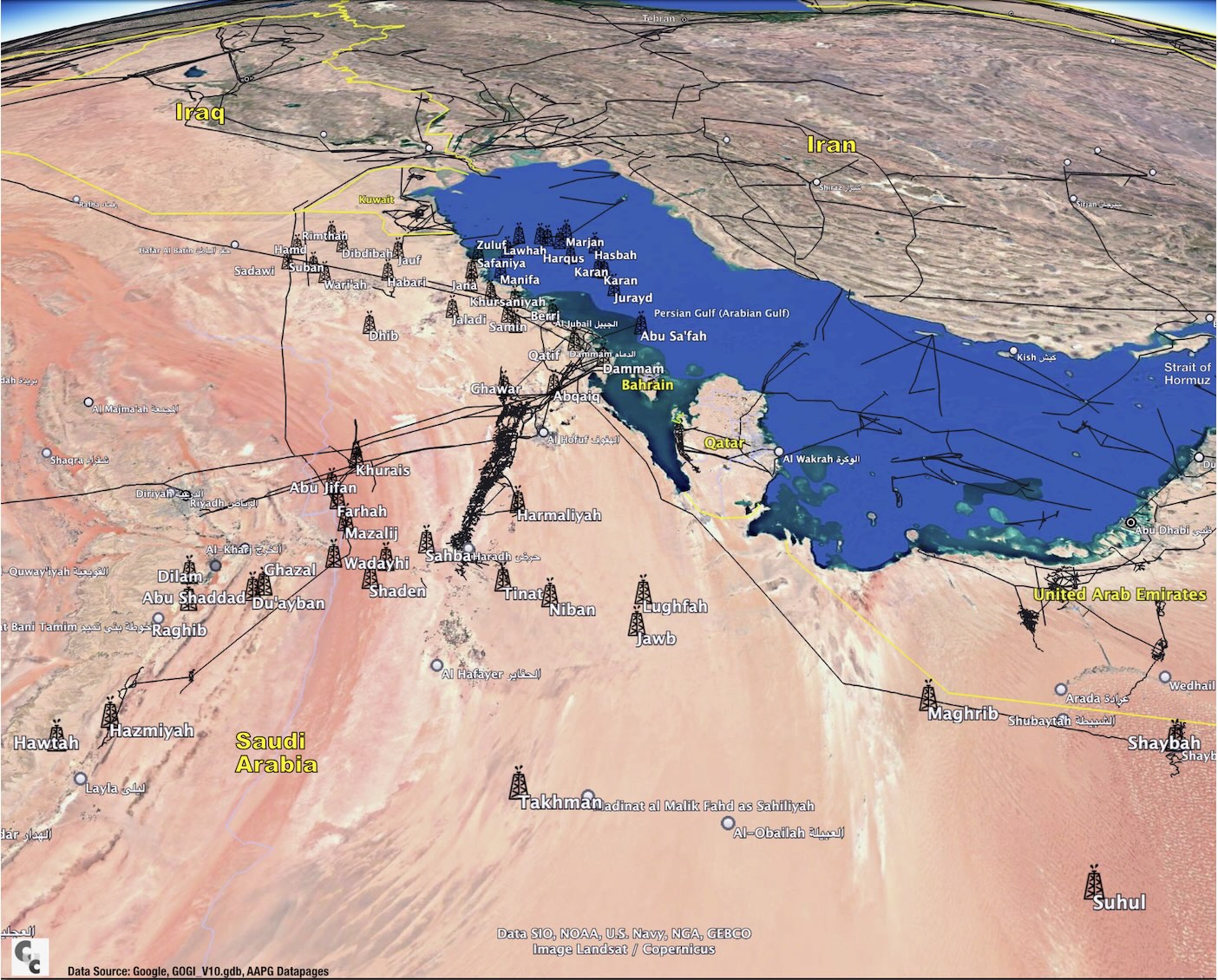
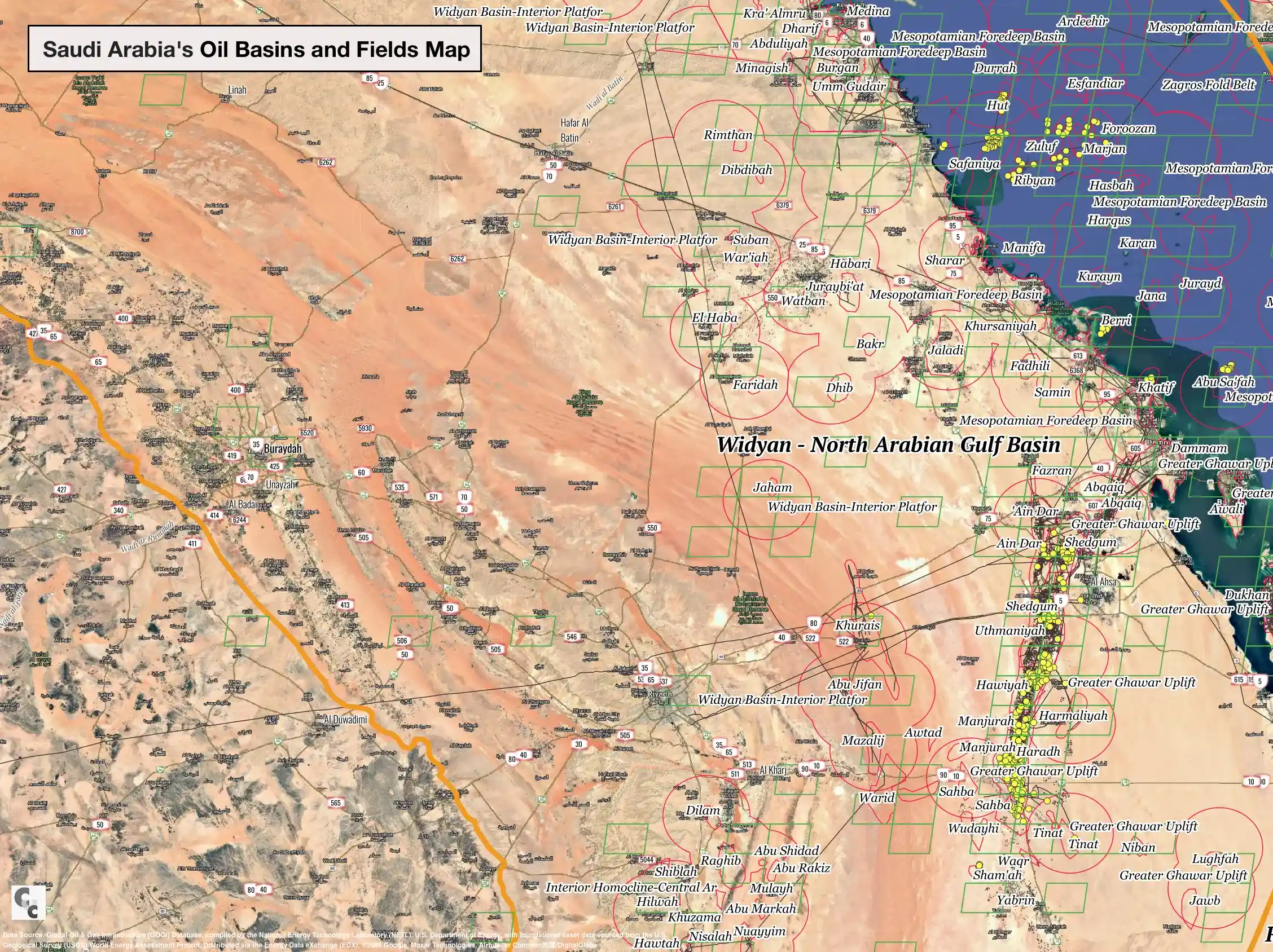
Saudi Arabia Major Oil Fields
Offshore Oil and Strategic Geography
While much production comes from onshore fields, offshore output—especially from Safaniya and nearby Persian Gulf fields—
provides diversification and resilience. Saudi Arabia’s geographic position near key shipping lanes enables efficient
exports to Asia and Europe.
The East-West Petroline pipeline can move roughly 5 million bpd across the country to Red Sea ports,
allowing exports to bypass the Strait of Hormuz if necessary.
Total Oil Production and Historical Output
Since the 1940s, Saudi Arabia has produced enormous volumes of petroleum:
- Estimated historical production exceeding 150 billion barrels
- Peak annual production over 10.5–11 million bpd
- Long-term average output near 8–10 million bpd in recent decades
The Kingdom frequently adjusts production levels to stabilize global markets, especially within OPEC and OPEC+ agreements.
Natural Gas Development
Although historically focused on oil, Saudi Arabia has expanded natural gas development to fuel domestic industry and reduce
crude use in power generation. Current estimates include:
- 300+ trillion cubic feet of proven gas reserves
- Annual production around 120–130 billion cubic meters
- Major unconventional gas projects like the Jafurah shale field
Most Saudi gas is consumed domestically for electricity, desalination, and petrochemicals rather than export.
Oil Exports and Global Market Influence
Saudi Arabia remains the world’s largest crude oil exporter, typically shipping:
- 6–8 million barrels per day of crude exports
- Additional exports of refined products and petrochemicals
- Roughly 15–20% of globally traded crude oil
Major export destinations include China, Japan, India, South Korea, and Europe (depending on geopolitical conditions).
Oil revenues historically account for 60–80% of government income, making global oil prices critical to the Saudi economy.
Reserves and Future Outlook
Despite decades of massive extraction, Saudi Arabia still holds some of the world’s largest remaining petroleum reserves.
With more than 260 billion barrels of proven oil reserves, the Kingdom maintains a reserves-to-production ratio of
roughly 60–70 years.
Ongoing exploration, enhanced oil recovery, and offshore development continue to extend resource longevity.
At the same time, Saudi Arabia is pursuing economic diversification under Vision 2030 while investing in hydrogen,
carbon capture, and petrochemicals to maintain long-term energy influence.
Oil Field Data Key
- EUR_MMBOE: Estimated Ultimate Recovery in million barrels of oil equivalent (MMBOE).
- RSVS_MMBOE: Reserves in million barrels of oil equivalent (MMBOE).
- EURO_MMBO: Estimated Ultimate Recovery of oil in million barrels of oil (MMBO).
- EURG_TCFG: Estimated Ultimate Recovery of gas in trillion cubic feet of gas (TCFG).
- EURC_MMBO: Estimated Ultimate Recovery of condensate in million barrels of oil (MMBO).
- HL10_MMBOE: Hydrocarbon recovery estimate at a 10% decline rate in million barrels of oil equivalent (MMBOE).
- HL20_MMBOE: Hydrocarbon recovery estimate at a 20% decline rate in million barrels of oil equivalent (MMBOE).
- HL50_MMBOE: Hydrocarbon recovery estimate at a 50% decline rate in million barrels of oil equivalent (MMBOE).
- PRV_USGS_C: Proven reserves or production estimate from the U.S. Geological Survey (USGS).
- PRV_USGS_N: Name of the basin or area of interest identified by the USGS (e.g., San Juan Basin).
- BSN_TELL_C: Basin classification code (e.g., BS000000715).
- BSN_TELL_N: Basin name (e.g., San Juan Basin).
- BSN_BALLY: Basin type classification (e.g., Type 2).
- RSVR_NAME: Reservoir name (e.g., Barnett).
- RSVR_LITH1: Reservoir lithology or rock type (e.g., Shale).
- RSVR_LITH2: Secondary reservoir lithology (e.g., fractured shale).
- ERA: Geological era (e.g., Mesozoic).
- SYSTEM: Geological system (e.g., Cretaceous).
- SERIES: Geological series (e.g., Upper Cretaceous).
- STAGE: Geological stage (e.g., Primary Oil migration).
- AGE_CODE: Geological age code (e.g., MZ_CT_U: Mesozoic, Cretaceous, Upper).
- RSVR_DEPFT: Reservoir depth in feet (e.g., 6065 feet).
- RSVR_DEPKM: Reservoir depth in kilometers (e.g., 1.85 km).
- TRAP_CLASS: Trap classification (e.g., Stratigraphic).
- TRAP_TYPE: Trap type (e.g., Pinch-out).
- TRAP_DESC: Trap description (e.g., Porosity wedge, stratigraphic).
Saudi Arabia Oil Fields — Complete Field List
Abqaiq Field, Saudi Arabia, Discovered 1940, Supergiant Field
Abu Hadriya Field, Saudi Arabia, Discovered 1940, Giant Field
Abu Jifan Field, Saudi Arabia, Discovered 1973, Giant Field
Abu Sa'fah Field, Saudi Arabia, Discovered 1963, Supergiant Field
Abu Shaddad Field, Saudi Arabia, Discovered 1996, Giant Field
Barqan Field, Saudi Arabia, Discovered 1969, Giant Field
Berri Field, Saudi Arabia, Discovered 1964, Supergiant Field
Dammam Field, Saudi Arabia, Discovered 1938, Giant Field
Dhib Field, Saudi Arabia, Discovered 1979, Giant Field
Dibdibah Field, Saudi Arabia, Discovered 1975, Giant Field
Dilam Field, Saudi Arabia, Discovered 1989, Giant Field
Dorra Field, Saudi Arabia, Discovered 1967, Giant Field
Du'ayban Field, Saudi Arabia, Discovered 2005, Giant Field
Fadhili Field, Saudi Arabia, Discovered 1949, Giant Field
Farhah Field, Saudi Arabia, Discovered 1984, Giant Field
Ghawar Field, Saudi Arabia, Discovered 1948, Megagiant Field
Ghazal Field, Saudi Arabia, Discovered 2000, Giant Field
Habari Field, Saudi Arabia, Discovered 1976, Giant Field
Hamd Field, Saudi Arabia, Discovered 1982, Giant Field
Hamur Field, Saudi Arabia, Discovered 1979, Giant Field
Harmaliyah Field, Saudi Arabia, Discovered 1971, Giant Field
Harqus Field, Saudi Arabia, Discovered 1978, Giant Field
Hasbah Field, Saudi Arabia, Discovered 1976, Giant Field
Hawtah Field, Saudi Arabia, Discovered 1989, Giant Field
Hazmiyah Field, Saudi Arabia, Discovered 1990, Giant Field
Hout Field, Saudi Arabia, Discovered 1963, Giant Field
Jaladi Field, Saudi Arabia, Discovered 1978, Giant Field
Jana Field, Saudi Arabia, Discovered 1967, Giant Field
Jauf Field, Saudi Arabia, Discovered 1983, Giant Field
Jawb Field, Saudi Arabia, Discovered 1979, Giant Field
Jurayd Field, Saudi Arabia, Discovered 1968, Giant Field
Karan Field, Saudi Arabia, Discovered 1967, Giant Field
Karan Field, Saudi Arabia, Discovered 2006, Giant Field
Khafji Field, Saudi Arabia, Discovered 1959, Supergiant Field
Khurais Field, Saudi Arabia, Discovered 1957, Supergiant Field
Khursaniyah Field, Saudi Arabia, Discovered 1956, Giant Field
Lawhah Field, Saudi Arabia, Discovered 1975, Giant Field
Lughfah Field, Saudi Arabia, Discovered 1979, Giant Field
Maghrib Field, Saudi Arabia, Discovered 1983, Giant Field
Maharah Field, Saudi Arabia, Discovered 1973, Giant Field
Manifa Field, Saudi Arabia, Discovered 1957, Supergiant Field
Marjan Field, Saudi Arabia, Discovered 1967, Supergiant Field
Mazalij Field, Saudi Arabia, Discovered 1971, Giant Field
Niban Field, Saudi Arabia, Discovered 1999, Giant Field
Qatif Field, Saudi Arabia, Discovered 1945, Supergiant Field
Qubqub Field, Saudi Arabia, Discovered 1977, Giant Field
Raghib Field, Saudi Arabia, Discovered 1990, Giant Field
Rimthan Field, Saudi Arabia, Discovered 1974, Giant Field
Sadawi Field, Saudi Arabia, Discovered 1976, Giant Field
Safaniya Field, Saudi Arabia, Discovered 1951, Megagiant Field
Sahba Field, Saudi Arabia, Discovered 1984, Giant Field
Samin Field, Saudi Arabia, Discovered 1979, Giant Field
Shaden Field, Saudi Arabia, Discovered 1999, Giant Field
Sharar Field, Saudi Arabia, Discovered 1976, Giant Field
Shaybah Field, Saudi Arabia, Discovered 1968, Supergiant Field
Suban Field, Saudi Arabia, Discovered 1976, Giant Field
Suhul Field, Saudi Arabia, Discovered 1977, Giant Field
Takhman Field, Saudi Arabia, Discovered 2002, Giant Field
Tinat Field, Saudi Arabia, Discovered 1982, Giant Field
Wadayhi Field, Saudi Arabia, Discovered 1998, Giant Field
Wari'ah Field, Saudi Arabia, Discovered 1978, Giant Field
Zuluf Field, Saudi Arabia, Discovered 1965, Supergiant Field
Data Source: Dr. M. K. (Mike) Horn/AAPG Datapages compilation
Return to Map Index
Copyright CCCarto 2026