Early Discovery and Economic Rise
Brunei's oil history began in the early 20th century, with the discovery of oil in the onshore Seria field in 1929. This discovery marked the beginning of Brunei's journey to becoming one of the wealthiest nations per capita in Southeast Asia. By the mid-20th century, oil and gas had become the country's primary economic driver, far surpassing traditional agriculture and trade. The government solidified its control over the oil industry by establishing an equal partnership with Royal Dutch Shell to form Brunei Shell Petroleum (BSP), which manages the major hydrocarbon assets in the country.
Production Growth and Challenges
Over the past 40 years, Brunei's oil production has experienced both growth and challenges. In the late 1970s, the country was producing around 250,000 barrels per day (bpd) and had numerous active onshore and offshore platforms. The number of active oil fields and derricks in Brunei has fluctuated due to various factors including the natural maturation of older fields, investment levels, and shifting exploration strategies. Currently, Brunei operates several major active fields—producing around 100,000 bpd—but the exact number of operational derricks is less clear, as it depends on specific industry practices and the use of enhanced oil recovery technologies.
Global Shifts and Reserve Depletion
The decline in oil prominence is attributed to a variety of factors including global shifts towards renewable energy, natural reservoir depletion, and the impact of global economic conditions on oil prices. While Brunei remains a significant net oil and gas exporter, the country faces challenges such as aging infrastructure in its oldest fields, over-reliance on a single economic sector, and environmental concerns. The rate at which Brunei's oil reserves will be depleted is uncertain and depends on factors such as future discoveries, technological advances in extraction, and changes in global energy policies. Estimates suggest that Brunei's proven oil reserves could last a few more decades at current export rates, but this is subject to change with new discoveries and shifts in production strategies.
Major Oil and Gas Fields
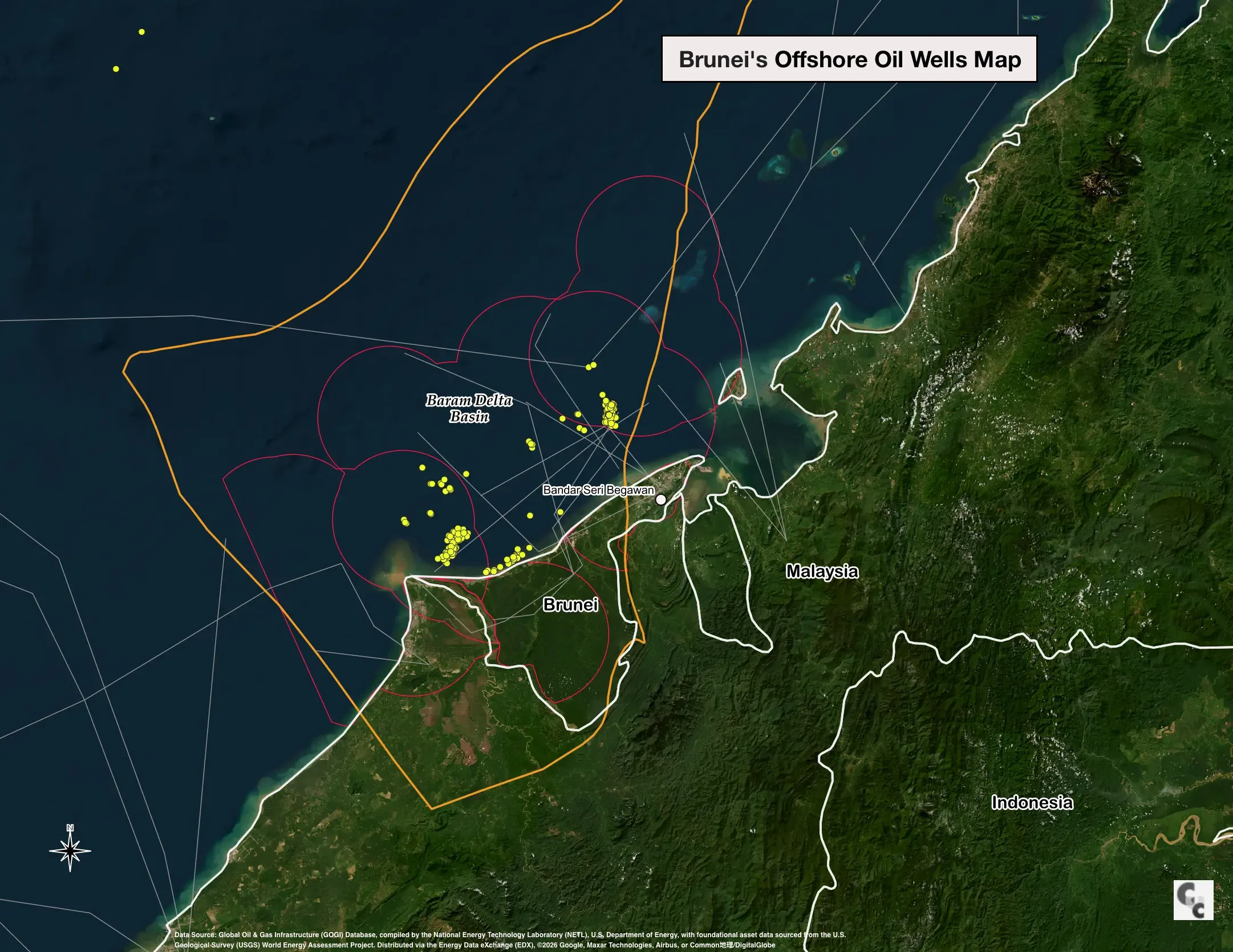
The largest oil and gas fields in Brunei are primarily located along the coastline and offshore in the shallow waters of the South China Sea. The offshore Champion field is one of the largest, historically accounting for a significant portion of Brunei's daily oil output. The onshore Seria field and the offshore Fairley field are also significant, contributing substantially to Brunei's overall petroleum production. In terms of gas fields, the South West Ampa and Maharaja Lela fields are notable, with substantial reserves that feed the nation's massive liquefied natural gas (LNG) operations. The size and production of these fields can vary, but they play a crucial role in Brunei's economy, contributing to both domestic energy needs and international exports.