
Nevada Gold Mines Map
The History of Gold Mining in Nevada
The history of gold mining in Nevada is a tale of boom and bust, of fortune-seekers, and of powerful corporations that shaped the state's economy and development. Gold was first discovered in Nevada in the 1840s, but it wasn't until the Comstock Lode discovery in 1859 that Nevada became synonymous with gold mining. Although the Comstock Lode is more famous for its silver output, gold was an essential part of the mineral wealth that was extracted.In the early days, prospectors such as Henry Comstock and Patrick McLaughlin stumbled upon rich deposits in the mountains of western Nevada. These men were among the first to exploit the rich mineral veins of the Comstock Lode, but the complexities of mining led them to sell their claims to more experienced miners and entrepreneurs. Soon, corporations and wealthy investors took over the mining operations, leading to the development of large-scale mining operations.
By the 1860s, Nevada had become a hub for mining activity, with corporations like the Gould & Curry Mining Company and the Ophir Mining Company playing significant roles in the extraction of gold and silver. The influx of capital and technology transformed Nevada's mining landscape from a frontier operation to a sophisticated industrial enterprise. The Virginia City area, where the Comstock Lode was located, became one of the most productive mining regions in Nevada and led to the establishment of the city as a bustling hub of commerce and culture.
Major Gold Mining Regions and Types of Gold Found
Nevada's gold mining has spanned across many regions, but some of the most productive areas have been in the northern part of the state. The Carlin Trend, discovered in the 1960s, is perhaps the most famous gold-producing region in Nevada. Stretching over 40 miles, this area has produced millions of ounces of gold and is known for its microscopic gold particles, often found in disseminated deposits. Unlike the nuggets of gold found in placer deposits, the gold in the Carlin Trend is found in tiny particles within sedimentary rocks, making it difficult to extract without modern technology.Another significant area is the Battle Mountain-Eureka Trend, which includes the Cortez and Pipeline mines, both of which have produced substantial amounts of gold. The Walker Lane Belt, located in the western part of Nevada, is also known for its rich gold deposits, including the famous Goldfield district.
Successful Mining Techniques in Nevada
Gold mining in Nevada has evolved significantly over the years, employing various techniques to extract the precious metal. Early prospectors relied on placer mining methods such as panning, sluicing, and rocker boxes to sift through riverbeds and streams for gold nuggets and flakes. However, as surface deposits were exhausted, miners turned to more advanced methods.Hydraulic mining, which uses high-pressure water to wash away entire hillsides, was briefly popular but led to significant environmental damage. The introduction of deep rock mining allowed miners to access gold buried deep within the earth, particularly in the Carlin Trend, where the gold was locked in microscopic particles within the rock.
By-product gold mining, where gold is extracted as a secondary product from mining operations focused on other metals, also became common, particularly in copper and silver mines. The cyanide process, which involves dissolving gold out of crushed ore using cyanide, became the most successful and widely used method in Nevada, particularly in the Carlin Trend where traditional methods were ineffective.
Famous Gold Strikes and Richest Veins
Nevada is home to some of the richest gold strikes and veins in the world. The Comstock Lode, although primarily a silver discovery, produced significant amounts of gold, helping to fund the Union during the Civil War. The Carlin Trend, discovered by geologist John Livermore in 1961, is considered one of the most significant gold discoveries of the 20th century, yielding over 100 million ounces of gold to date.Other famous strikes include the Goldfield district, which produced some of the richest ore ever found, with gold content as high as $1,000 per ton in the early 20th century. The Round Mountain mine, one of the largest open-pit mines in the world, continues to produce significant amounts of gold today.
Nevada Cities Built Around Gold Mining
Gold mining played a crucial role in the development of Nevada's cities. Virginia City, perhaps the most famous mining town, grew rapidly after the discovery of the Comstock Lode, becoming one of the wealthiest cities in the United States during the late 19th century. Goldfield, another prominent mining town, flourished in the early 1900s after the discovery of rich gold deposits.Other towns like Elko, Eureka, and Tonopah also owe their origins to the mining industry. These towns became centers of commerce, with banks, saloons, and theaters springing up to serve the miners and their families. Today, many of these towns have either faded into ghost towns or transformed into modern communities, but their histories are deeply intertwined with Nevada's gold mining heritage.
The Gold Market and Environmental Impact
Gold mined in Nevada is typically sold on the global market, with much of it refined and used in various industries, including jewelry, electronics, and investment. Nevada's gold is often transported to major refineries in the United States or abroad, where it is processed into bars or coins. The Nevada State Mint, established in Carson City in 1870, was historically significant in minting gold coins, although it ceased operations in 1893. The coins minted there, especially the Carson City gold dollars, are now valuable collector's items.The environmental costs of gold mining in Nevada have been substantial. The use of cyanide in the extraction process, while efficient, poses significant risks to the environment, including water contamination. Open-pit mining, common in Nevada, leads to habitat destruction and large-scale landscape alteration. Mercury, historically used in gold mining, has also left a legacy of pollution in certain areas. However, modern regulations have sought to mitigate some of these impacts, with companies required to implement reclamation plans to restore mined land.
Current Gold Mining Operations and Recreational Mining
Nevada remains one of the top gold-producing states in the U.S., with several active mines such as the Carlin Complex, Cortez, and Round Mountain. These mines continue to produce significant quantities of gold, contributing to Nevada's economy. The living conditions for miners have improved considerably, with modern housing, healthcare, and safety standards in place. Gold miners in Nevada today generally earn competitive wages, and many are employed by large, multinational corporations that provide benefits and job security.Recreational gold mining is also popular in Nevada, with hobbyists seeking permits to pan or use metal detectors in public lands designated for this purpose. To legally mine recreationally, one must obtain a prospecting permit from the Bureau of Land Management (BLM) and ensure that their activities do not disturb the environment or infringe on active mining claims. Equipment used by hobbyists can range from simple pans to more advanced metal detectors and sluice boxes, depending on the location and method of mining.
Early History of the Carson City Mint
The Carson City Mint was established in 1863 by the U.S. Congress during Nevada’s booming silver and gold mining era, particularly following the discovery of the **Comstock Lode** in 1859. Construction of the mint began in 1866, and it officially opened for operations in 1870. Its purpose was to process the vast quantities of silver and gold ore being mined in Nevada and surrounding regions, so coins could be struck locally instead of shipping bullion to San Francisco or Philadelphia. The building itself, designed by Alfred B. Mullett (Supervising Architect of the U.S. Treasury), was constructed of sandstone quarried nearby. The mint quickly became central to Nevada’s mining economy, converting raw bullion into coinage and bars. It symbolized both Nevada’s admission as a state (1864) and its importance to the Union during and after the Civil War.Gold Mining Connection
Although the Comstock Lode was primarily known for its silver, Nevada also produced significant amounts of gold. The Carson City Mint received deposits of both silver and gold from miners and processed them into U.S. coinage. Its strategic location near mining towns like Virginia City meant that miners could deposit bullion directly, avoiding the risks and costs of long transport to coastal mints. Gold mined in Nevada and nearby California was thus transformed into federal currency bearing the “CC” mintmark, which became iconic among collectors.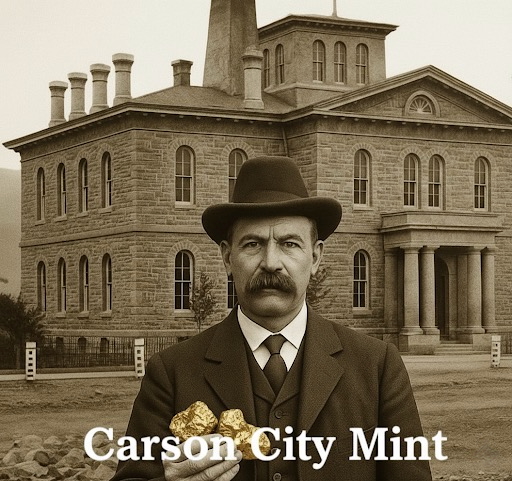
Famous Early Gold Coins Produced
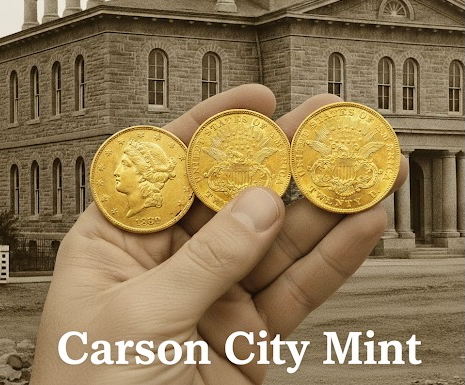
Before its closure in 1893, the Carson City Mint struck a number of now-famous gold coins, all bearing the distinctive **“CC” mintmark**. Among the most notable early issues were: Gold Half Eagles ($5 pieces, 1870–1893) – Scarce and highly collectible, with some low-mintage years. Gold Eagles ($10 pieces, 1870–1893) – Produced in small quantities, many now considered rare. Gold Double Eagles ($20 pieces, 1870–1893) – The largest denomination minted in Carson City, with the 1870-CC $20 being among the rarest and most valuable U.S. gold coins. In addition to gold, the mint also produced silver coins, including the famous Seated Liberty and Morgan silver dollars, which helped cement the “CC” mintmark’s legendary status in American numismatic history.Closure of the Mint
Coinage at Carson City ceased in 1893 as mining activity declined and political shifts reduced the demand for a regional mint. The building continued to serve other federal purposes, including as an assay office until 1933. Today, the former mint building houses the **Nevada State Museum**, where visitors can still see Coin Press No. 1, the original press used to strike Carson City coinage.Conclusion
Gold mining in Nevada has a rich and complex history, marked by significant discoveries, economic booms, and environmental challenges. From the early prospectors who first struck gold to the modern corporations that continue to extract the precious metal, Nevada's gold mining industry has played a pivotal role in shaping the state's development. Despite the environmental costs, gold mining remains a crucial part of Nevada's economy, with active mines continuing to produce large quantities of gold. The legacy of Nevada's gold rush can still be felt today, both in the cities that were built around the mines and in the ongoing interest of recreational miners seeking to strike it rich in the Silver State.Source: U.S. Geological Survey, Major mineral deposits of the world, Open-File Report 2005-1294. Data portal