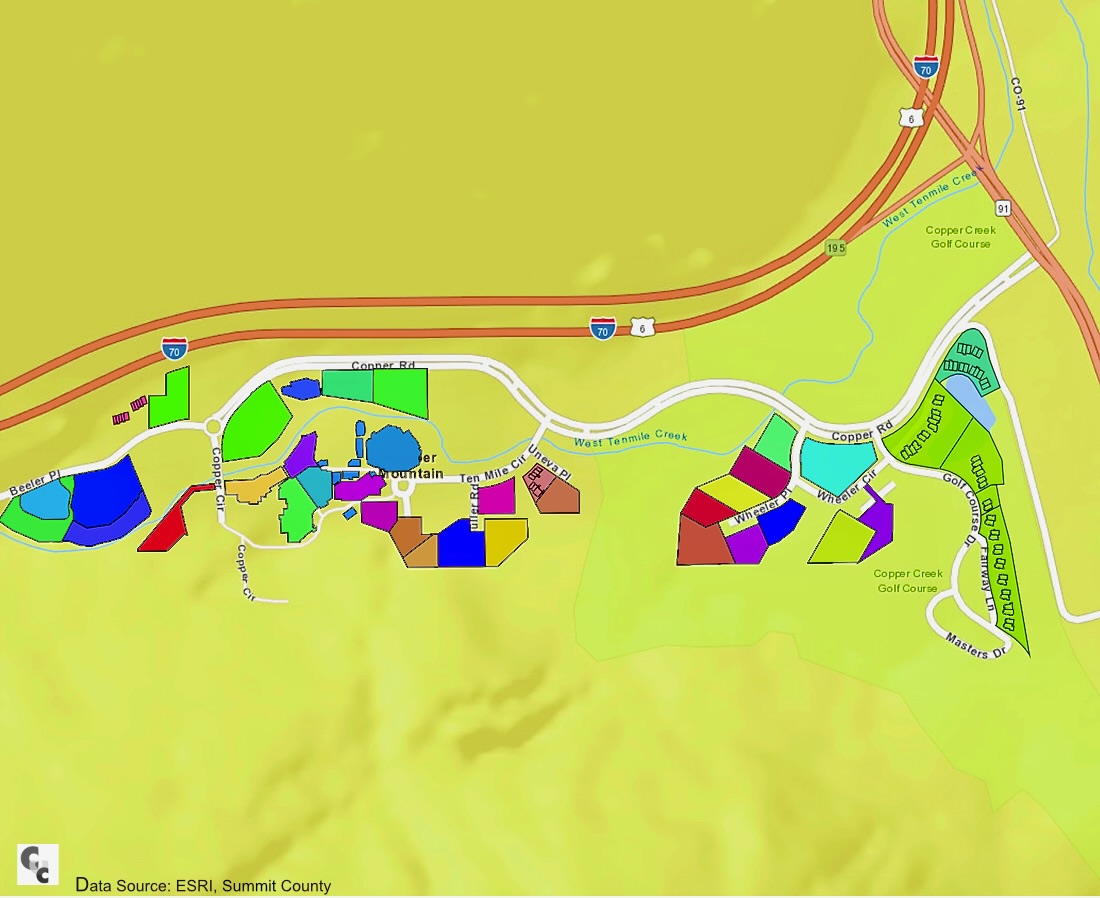
Copper Mountain, Colorado – History and Overview of Ski Condominiums
Copper Mountain in Summit County, Colorado, is one of the classic purpose-built ski resorts in the central Rockies. Rather than growing from a historic mining town, the modern resort and its condo villages were designed together from the early 1970s, so the built environment is dominated by multi-family buildings: condominiums, condo-hotels and townhomes clustered at the base of the lifts.
Early Years and the First Condominiums (1970s)
The Copper Mountain Ski Resort opened for the 1972–73 winter season, after several years of planning and construction on the eastern flank of Copper Mountain in the Tenmile Range. From the beginning, the business model combined lift-served skiing with slopeside condominium lodging. According to the resort’s historical timeline, the opening years saw the construction of several base-area condo and lodge buildings in what is now Center Village, including Copper Junction, Summit House, Ten Mile Haus and Timber Creek, all clustered near the main lifts and along Tenmile Creek. These early buildings formed the core of the original pedestrian village at the base of the American Eagle and Flyer lifts.
Through the later 1970s and early 1980s, additional mixed-use condo buildings went up around Center Village and toward today’s East and West Villages. Mountain Plaza, a large mid-rise lodge in the heart of Center Village, was completed in 1979. In the early 1980s, West Lake Lodge and the Beeler Place townhomes were built near the small lake and western edge of the village, while Spruce Lodge and expansions to Village Square added more condo-hotel style units steps from the lifts. By the mid-1980s, Copper already had a substantial inventory of ski-in/ski-out or short-walk condo buildings arranged around the main base area.
Expansion Waves and the Newest Condo Projects
Most of Copper Mountain’s original condo stock dates to the 1970s and early 1980s, but a second major wave of development arrived when Intrawest acquired the resort in the late 1990s. Between roughly 1998 and 2000, the company invested heavily in modernizing the base villages and adding newer lodge-style condo buildings.
In East Village, at the base of the high-speed Super Bee lift, Copper Springs Lodge was completed in 1998. The building is often cited as the newest major residential structure in East Village and includes more than 100 individual condo units in one-, two- and three-bedroom configurations. In Center Village, Intrawest added or redeveloped several prominent buildings at the base of the American Eagle and Flyer lifts, including Tucker Mountain Lodge (completed around 2000) and Copper One (built around 2001), along with similar lodge-style buildings such as Taylor’s Crossing and Passage Point. These projects created a continuous ring of modern condos around the central plaza and ice rink.
On the west side of the resort, near Union Creek and beginner terrain, development focused more on lower-rise townhomes and high-amenity properties, such as The Cirque (an upscale condo property with pools and hot tubs) and later phases of the Cache at Union Creek. Most of these West Village projects were built in the early to late 2000s and represent the last large wave of new construction at the Copper base areas. In recent years, investment has shifted more toward interior remodels, energy upgrades, and amenity improvements in existing buildings rather than entirely new condo towers.
How Many Condo Units Exist Today?
Copper Mountain is an unincorporated census-designated place (CDP) within Summit County, with a permanent population of about 650 residents and a land area of roughly 83 square kilometers. The community is dominated by vacation properties rather than detached, year-round homes. Census and local housing data show that there are well over a thousand housing units in the CDP, and the vast majority of those units are in multi-family buildings—condominiums, condo-hotels and townhomes clustered in Center Village, East Village and West Village.
Prices Then and Now
Detailed, resort-specific sales data from Copper Mountain’s earliest years are limited, but historic ski-industry sources and period travel guides provide some context. Mid-1970s brochures described Copper’s new “condominium apartments” as modern units with full kitchens and fireplaces, offered both for sale and as nightly rentals. Nightly rental rates for these brand-new units often ranged from roughly $12 to $50 per night in the mid-1970s, which reflects the lower overall cost of lodging at the time, even in prime ski locations.
Sales advertisements from comparable Colorado ski resorts in that era typically offered studios and small one-bedroom condos in the tens of thousands of dollars, with larger two-bedroom units often in a higher—but still modest by today’s standards—price band. Adjusted for inflation, those 1970s prices translate into something like the low- to mid-six-figure range in today’s dollars, but still below current sale prices for most slopeside lodging in Summit County. Exact average purchase prices for Copper’s first-generation condos are not well documented in public datasets, and values varied by building, size, and proximity to lifts.
Modern market data paint a very different picture. Recent real estate reports for Copper Mountain indicate that:
- The average sale price for properties at Copper Mountain in recent years has been around $1.1–$1.2 million, with an average price per square foot near or just under $1,000 per square foot for many slopeside condo buildings.
- Broad estimates of home values (across all property types) place the typical Copper Mountain property in the $800,000–$900,000 range, although smaller studios and one-bedroom units often sell for less, and large, remodeled three-bedroom units or townhomes in premium locations can reach or exceed $1.5–$2 million.
In short, early condos at Copper Mountain were relatively affordable (by modern resort standards), often selling for tens of thousands of dollars, whereas today’s market is firmly in the high six- to seven-figure range for most lift-adjacent units.
Condos vs. 7,000-Square-Foot Homes: Environmental Considerations
From an energy and climate perspective, multi-family condos are generally more efficient than large stand-alone homes—especially in a high-altitude, cold-winter climate like Copper Mountain’s. National residential energy surveys consistently find that households in multifamily buildings (especially those with five or more units) use significantly less energy per household than detached single-family homes. Shared walls, smaller average floor area, and compact building shapes reduce heat loss and lower heating fuel and electricity use. Life-cycle assessments also typically show lower per-capita greenhouse gas emissions for multifamily housing, because the structure, foundations and infrastructure are shared by many households instead of serving a single large residence.
By contrast, a 7,000-square-foot mountain home usually has:
- Substantially greater heated volume, often with tall great rooms and large window walls.
- A larger building envelope exposed to cold and wind.
- Driveways, parking areas and utility runs dedicated to a single dwelling.
Even with modern insulation and high-efficiency systems, a very large detached house typically consumes far more energy and materials per household than a typical 800–1,500-square-foot ski condo. That said, the true footprint depends on occupancy (how many people use the space and how often), construction materials, and whether the building has undergone energy retrofits. Well-designed new single-family homes can be more efficient than older, poorly insulated condos; but on average, Copper’s condo-style lodging is a more compact and resource-efficient way to house visitors near the lifts than a landscape of scattered 7,000-square-foot houses would be.
How Regulations Have Changed Since the Early Years
When Copper Mountain’s first condo buildings were constructed in the early 1970s, local zoning and building codes were far less detailed than they are today. Energy codes were minimal, wildfire risk was only loosely considered, and environmental protections for wetlands, riparian areas and wildlife were not as developed as current policies.
Today, new condo or townhome projects at Copper fall under a much more comprehensive regulatory framework, including:
- Modern building and energy codes that require higher levels of insulation, tighter building envelopes, safer egress, sprinklers in many occupancies, and more efficient heating and ventilation systems.
- Wildfire and hazard mitigation requirements developed through Summit County’s multi-hazard mitigation planning process, which promote defensible space, fuel reduction, and resilient infrastructure throughout the wildland–urban interface, including around resort communities such as Copper Mountain.
- Land Use and Development Code standards that require protection or mitigation for sensitive resources such as wetlands, streams, steep slopes and wildlife habitat, as well as design guidelines aimed at reducing visual impacts on ridgelines and major view corridors.
- Short-term rental (STR) licensing and zoning rules that place Copper Mountain within a Resort Overlay Zone, where nightly rentals are broadly allowed but must comply with licensing, occupancy, safety and tax requirements.
Taken together, these regulations mean that any new condo building at Copper faces higher up-front costs and a more complex review process than the original 1970s lodges did, but they also help reduce environmental impacts and improve public safety.
Renting Condos, Townhomes and Duplexes to Offset Costs
Short-term rental income is a core part of the ownership pattern at Copper Mountain. Many condos in Center, East and West Village are zoned and designed to operate either as traditional condo-hotel units or as individually owned vacation rentals. Local property-management companies and national booking platforms handle marketing, housekeeping and guest services, making it relatively straightforward for owners to place units into rental programs when they are not using them.
Countywide research on Summit County’s resort communities shows that:
- Short-term rentals (STRs) support thousands of local jobs and generate hundreds of millions of dollars in economic output and local tax revenues each year.
- The vast majority of STR owners are small-scale, with only a single property in the rental pool, rather than large corporate portfolios.
This pattern fits what is seen at Copper, where a large share of condo and townhome owners rely on some level of rental income—from a few weeks per year up to near full-time nightly rentals—to help cover association dues, property taxes, utilities and mortgage costs. At the same time, concerns about neighborhood character, housing affordability for local workers, and infrastructure strain have led Summit County and individual homeowner associations to adopt more detailed rules about occupancy, parking, noise and permitting.
Biggest Long-Term Threats to Continued Condo Development
Several forces shape the long-term outlook for additional condo development at Copper Mountain. Some are environmental, others economic or regulatory:
- Climate change and snow reliability. Scientific studies and winter-sports research show that Colorado winters have warmed significantly over the past century, with declining snowpack at many monitoring sites, shorter average ski seasons, and increased reliance on snowmaking. While Copper’s high elevation helps preserve relatively good snow conditions compared with lower-elevation resorts, a warming climate still threatens to shorten the season and increase operational costs. Over the very long term, this could affect the attractiveness of financing entirely new condo projects tied closely to winter tourism.
- Wildfire risk and smoke. Copper Mountain sits within a forested, high-elevation landscape that carries a notable wildland–urban interface risk. Wildfire-risk assessments classify the community as having higher risk than most U.S. communities, and Summit County’s hazard-mitigation plans emphasize fuels reduction, defensible space and evacuation planning. Direct fire damage, persistent smoke, and higher insurance costs all pose potential challenges for both existing and proposed condo developments.
- Limited land and over-development concerns. Summit County planning staff estimate that the county as a whole is already a high percentage of the way toward its realistic residential build-out. Around Copper, buildable land is constrained by steep slopes, wetlands, existing roads and lifts, and national forest boundaries. Many residents and visitors also express concerns about overdevelopment and the loss of open views. As a result, local decision-makers may be more inclined to favor rehabilitation and modest infill over large new condo complexes.
- Water, sewage and solid-waste capacity. Copper’s infrastructure—water supply, wastewater treatment, roads and solid-waste systems—was originally sized for a certain level of seasonal population. Upgrading treatment plants, storage tanks and collection networks to accommodate significantly more development is expensive and can raise environmental concerns, particularly in sensitive alpine watersheds. Any major new condo project must address these capacity questions as part of its approval process.
- Environmental regulation and wildlife habitat. State and county regulations governing wetlands, riparian corridors, hillside development and wildlife habitat have become more protective over time. Portions of Copper’s surroundings are important for high-elevation ecosystems and seasonal wildlife use. These protections do not prevent all development, but they do limit where and how additional buildings can be sited, and may make some parcels impractical for new condos without substantial mitigation.
- Cost of skiing, housing and food in a resort economy. As lift tickets, season passes, restaurant prices and housing costs rise, there is ongoing debate about how large the market is for additional high-priced condo units in mountain resorts. Copper Mountain competes with other Colorado and Western ski destinations for a finite pool of visitors and second-home buyers. Economic slowdowns or shifts in travel patterns can quickly affect demand for luxury ski condos.
- Short-term rental policy shifts. Because so many Copper Mountain condos depend on vacation-rental income, any significant tightening of short-term rental regulations—at the county level or statewide—could change the economics of owning and building new units. At the same time, policymakers must balance visitor demand with local workforce housing needs, infrastructure limits and resident quality of life.
Despite these challenges, Copper Mountain remains one of Colorado’s classic ski-in/ski-out condo resorts. The existing stock of 1970s, 1980s and late-1990s/2000s buildings continues to be remodeled and upgraded, and the resort’s compact, condo-focused village design is likely to remain the dominant pattern for lodging at the base of the slopes.
Sources
- Copper Mountain Resort – history and development timeline (including early 1970s condo construction, Mountain Plaza, West Lake Lodge, Beeler Place townhomes, Spruce Lodge and Village Square). visitcoppermountain.com/about-copper
- Copper Springs Lodge and late-1990s condo expansion (year built, unit counts, and relationship to East Village and Super Bee lift). mountain-living.com/copper-springs-lodge, resortrealestateexperts.com/neighborhoods/copper-springs-lodge
- Tucker Mountain Lodge and Copper One Lodge – build years and role in Center Village infill. sellmountainvacations.com/copper-mountain-lodging/mill-club
- Copper Mountain community and housing statistics (population and housing-unit context for the CDP). en.wikipedia.org/wiki/Copper_Mountain,_Colorado
- Recent Copper Mountain real estate market data (average sale prices, price-per-square-foot ranges and examples of current condo listings). coppercolorado.com – lodging & real estate resources, redfin.com – Copper Mountain housing market, zillow.com – Copper Mountain home values
- Historical ski-industry context on 1970s Colorado resort condominiums, including early descriptions of Copper Mountain condominium apartments and nightly rental rates. dmagazine.com – “Ski Country” (1975)
- U.S. residential energy use by housing type and life-cycle emissions comparisons between multifamily and single-family housing. eia.gov – Residential Energy Consumption Survey highlights, raleighnc.gov – Residential Energy Use by Housing Type
- Summit County planning, land-use, wetlands and wildlife-habitat protection policies; wildfire resilience and fuels-reduction programs. summitcountyco.gov – Land Use & Development Code, csfs.colostate.edu – Community Wildfire Protection resources
- Short-term rental regulations and resort overlay zoning in Summit County; economic importance of STRs in resort communities. summitcountyco.gov – Short-Term Rentals, rrcassociates.com – Short-Term Rentals in Resort Communities
- Climate change impacts on Colorado snowpack and the ski industry, including documented warming, reduced snow water equivalent and shortened ski seasons. epa.gov – Climate Change & Colorado Winter Sports, sustainability.colostate.edu – Changing Snowpack in Colorado
- Wildfire risk assessments and multi-hazard mitigation planning for Copper Mountain and Summit County. wildfirerisk.org – Copper Mountain wildfire risk overview, summitcountyco.gov – Multi-Hazard Mitigation Plans
Data source: County parcel data • CCCarto.com is not responsible for location errors, omissions, or out-of-date data. • Map © CCCarto.com 2026