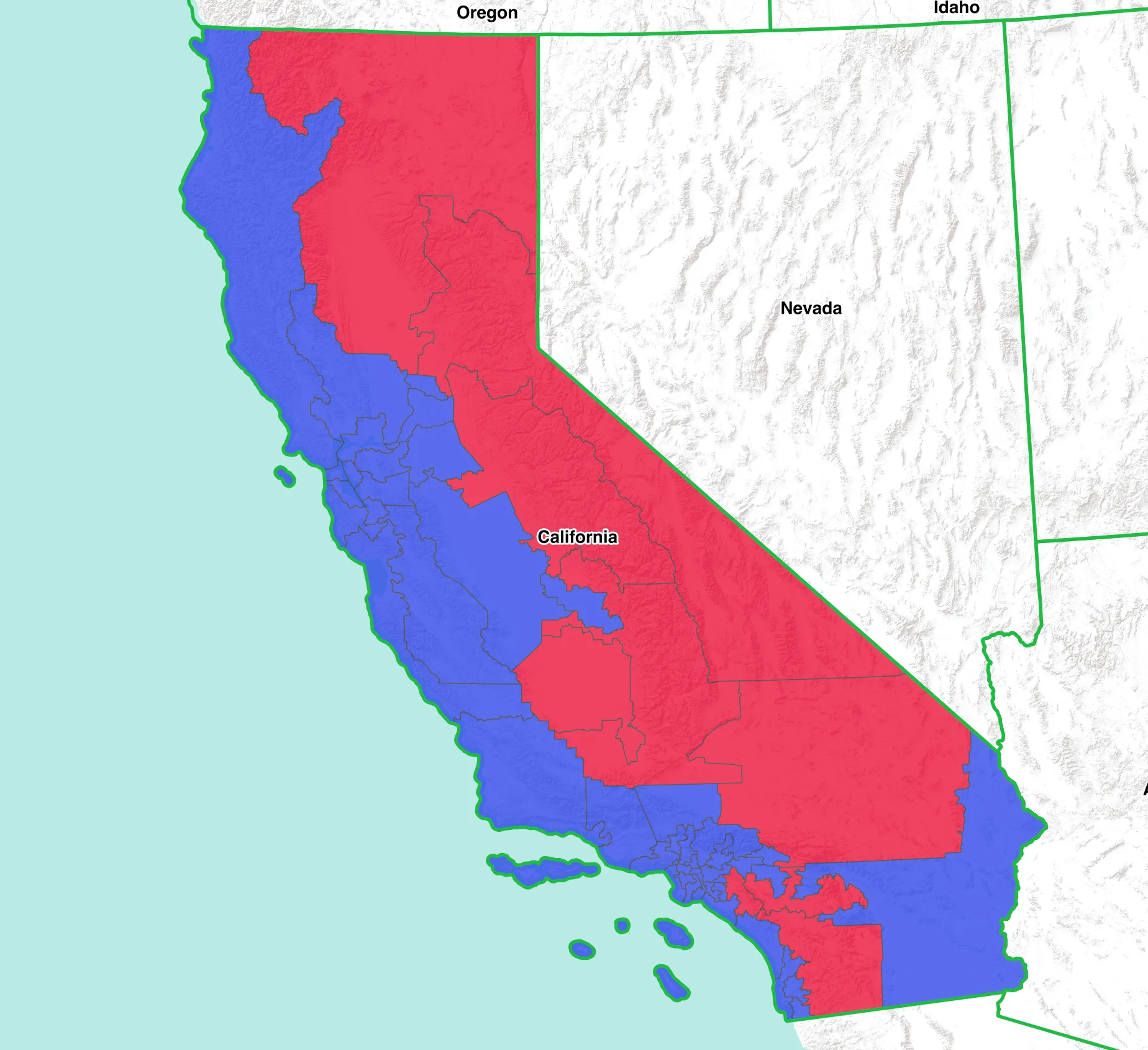
Compare California's 119th vs. New Redistricting Boundaries
Use this interactive map to compare California's current congressional districts with the new 2026/2028 boundaries and see if your local lines have changed.
Cartographer's Notes & Data Sourcing
To map this mid-decade redistricting comparison, raw electoral shapefiles for both the current 119th congressional districts and the new 2026/2028 boundaries were sourced directly from the California Citizens Redistricting Commission. The data polygons were processed using GIS and rendered as a simultaneous, clickable overlay on top of physical shaded relief to illustrate how the newly drawn political borders intersect with the state's natural terrain.
2026 Redistricting Update
Following the passage of Proposition 50 in November 2025, California has implemented a new legislatively-drawn congressional map for the 2026 election cycle. This mid-decade adjustment is expected to solidify several competitive districts.
Interactive Map Feature: Click anywhere on the California map to compare between the existing 119th Congress district and the new district to see if you are in a new district.
The 119th U.S. Congress convened on and runs through Jan 2027 due to redistricting.
It follows the November 5, 2024 federal elections (not 2022).
What are the major voter issues in California for the upcoming election(s)?
Economic Pressures: Cost of Living & Inflation
Everyday affordability remains a top voter concern. Debates are heavily focused on the persistently high cost of gas, groceries, and utilities. Candidates are clashing over the state's gas taxes, energy mandates, and strategies to curb inflation while maintaining the state's economic output.
Federal-State Relations & Sovereignty
The push-and-pull between Sacramento and Washington D.C. is a massive focal point. Key issues include "push-back" on federal immigration enforcement (ICE), arguments over state jurisdiction versus federal mandates, and the demand for forceful, uncompromising representation in Congress to defend California's specific legislative priorities.
Housing Construction & Homelessness
The state's housing shortage continues to dominate local and state elections. Voters are prioritizing policies surrounding zoning deregulation, the speed of new home construction, state mandates forcing cities to build, and the effectiveness of billions spent on the homelessness crisis.
Environmental Policy & Land Management
Climate change initiatives are a staple of California politics, but the conversation is shifting heavily toward actionable land management. This includes the struggle for state versus federal control over forest management to prevent devastating wildfires, water rights and drought infrastructure, and the timeline for transitioning to renewable energy.
Technology & The Evolving Workforce
As the global hub for tech development, California is uniquely facing the immediate economic impacts of Artificial Intelligence. The rapid integration of AI is prompting intense legislative debates over job displacement, workforce retraining, and how to regulate tech companies without stifling innovation.
Congressional Representation & Foreign Policy
While state elections typically focus on domestic issues, strong voter sentiment regarding U.S. involvement in foreign conflicts—specifically funding for overseas wars and policies regarding Israel and the Middle East—is heavily influencing Congressional races and voter turnout across the state.
Other Emerging Priorities: Public Safety & Water
Crime and Public Safety: Retail theft, property crime, and debates over modifying past criminal justice reforms (like Proposition 47) are major talking points for both gubernatorial and local races.
Water Infrastructure: Upgrading aging reservoirs and aqueducts to capture extreme rainfall and manage inevitable drought cycles.
Insurance Markets: The exodus of major property insurers due to wildfire risks has left many homeowners seeking urgent legislative intervention to stabilize the insurance market.
Why California Districts Held the Blue Line in 2024
In the 2024 elections, despite national economic headwinds, California's congressional map remained a Democratic fortress under the original lines drawn by the Citizens Redistricting Commission. The retention of competitive seats was driven by three core structural factors:
Suburban Realignment: Former conservative strongholds, particularly in Orange County and the Inland Empire, continued their shift. Highly educated, suburban voters firmly rejected the national platform, ensuring swing districts remained blue even when defending open seats.
Universal Vote-By-Mail: California's institutionalized mail-in ballot system creates a massive, high-turnout electorate, preventing the "voter drop-off" that Republicans traditionally rely on to win tight down-ballot races.
The Cultural Firewall: The nationalization of local congressional races around issues like reproductive rights and federal overreach effectively neutralized the conservative messaging that succeeded in other parts of the country.
Proposition 50 and the Mid-Decade "Blue Wave" (2026–2030)
The standard 10-year redistricting cycle was completely upended in November 2025. In direct response to mid-decade partisan redistricting in states like Texas, California voters passed Proposition 50, authorizing the temporary replacement of the independent commission's maps with a legislature-drawn map for the 2026 through 2030 elections.
The 2025 Special Election: Approved by over 64% of voters, Proposition 50 legally bypassed the Citizens Redistricting Commission. The new maps, drawn directly by the legislature, surgically target the few remaining Republican strongholds to offset GOP gerrymandering in other states.
The Geographic Shift: The new boundaries drastically alter the landscape by moving larger shares of urban and suburban Democratic voters into highly competitive or previously Republican-leaning districts. Key shifts occurred in areas like the Central Valley (CA-13, CA-21), Orange County (CA-45, CA-47), and San Diego (CA-48, CA-49), diluting conservative voting blocs by breaking up regions like the Temecula Valley and Placer County exurbs.
The 2026 Impact: Following federal court clearance in early 2026, these new borders are now locked in. By absorbing coastal transplants and diverse urban populations into previously tight districts, the legislature-drawn map establishes an overwhelming mathematical advantage for Democratic candidates, structurally engineered to secure a massive "Blue Wave" for the remainder of the decade until the 2030 census.
Sample Map Listing: Current California 119th Congressional Representatives
Showing 8 of 52 representatives. Click the interactive map above to view full details, contact info, and committee assignments for every district.
House control: Republican majority (narrow). Official count varies with vacancies;
Clerk’s Official List (Sept. 4, 2025) shows 219 R, 212 D, 4 vacancies.
Senate control: Republicans hold the majority (53–45–2 I).
What Changed After the 2024 Election
Senate flipped to GOP control with decisive wins in several battlegrounds; Republicans began the 119th with a majority.
House stayed Republican, but with a slim, shifting margin as resignations and special elections create periodic vacancies.
New members seated: dozens of first-term Representatives and a cohort of first-term Senators joined the 119th (see “New Members” below).
Find California’s U.S. Senators & Representative
Use these official directories to confirm the current roster for California and to get office contacts: