Earthquake Fault Maps
Click to explore interactive map
Hollister Earthquake Faults Map
View earthquakes for the last 30 days
Earthquake Faults near Hollister, CA
Hollister, situated in San Benito County, California, lies in a seismically active region characterized by several significant fault lines. The city is surrounded by a complex network of faults, each with its own type and activity level. The primary faults affecting Hollister include the San Andreas Fault, the Sargent Fault Zone, the Calaveras Fault Zone, the Quien Sabe Fault, the Zayante-Vergeles Fault Zone, the Loma Prieta Fault, and the Ortigalita Fault Zone.
The San Andreas Fault, a major fault line running through California, is a right-lateral strike-slip fault. This means that the two sides of the fault slide past each other horizontally. It is one of the most significant faults in the state and has a history of producing large earthquakes. The San Andreas Fault is relatively far from Hollister, but its seismic activity can still influence the area.
The Sargent Fault Zone is a complex system of faults located near Hollister. It includes both strike-slip and reverse faulting. This zone is an important source of seismic activity and contributes to the overall tectonic stress in the region.
The Calaveras Fault Zone is another prominent fault near Hollister. It is primarily a right-lateral strike-slip fault, similar to the San Andreas Fault, and has been known to produce significant earthquakes. The Calaveras Fault is located to the east of Hollister and is a major contributor to seismic risk in the region.
The Quien Sabe Fault is a less well-known fault located to the south of Hollister. It is primarily a reverse fault (thrust fault), which means that it accommodates compressional forces by pushing one block of the crust up over another. While not as prominent as the San Andreas or Calaveras faults, it still poses a seismic risk.
The Zayante-Vergeles Fault Zone is located further to the west of Hollister. It includes a combination of strike-slip and reverse faults. This fault zone is significant due to its potential for causing seismic activity in the region.
The Loma Prieta Fault, part of the larger San Andreas Fault system, is another fault of concern. It was the source of the 1989 Loma Prieta earthquake, which caused significant damage in the San Francisco Bay Area. Although it is located further to the north, its seismic effects can still be felt in Hollister.
The Ortigalita Fault Zone, situated to the southeast of Hollister, is a complex fault system with a mix of strike-slip and reverse faulting. This zone contributes to the overall seismic risk in the region and can influence the intensity of shaking during an earthquake.
In terms of activity, the San Andreas Fault, Calaveras Fault Zone, and Loma Prieta Fault are among the most active and pose significant seismic risks to Hollister. The Sargent Fault Zone and Ortigalita Fault Zone also contribute to the area's seismic hazard, although they are less prominent compared to the San Andreas and Calaveras faults.
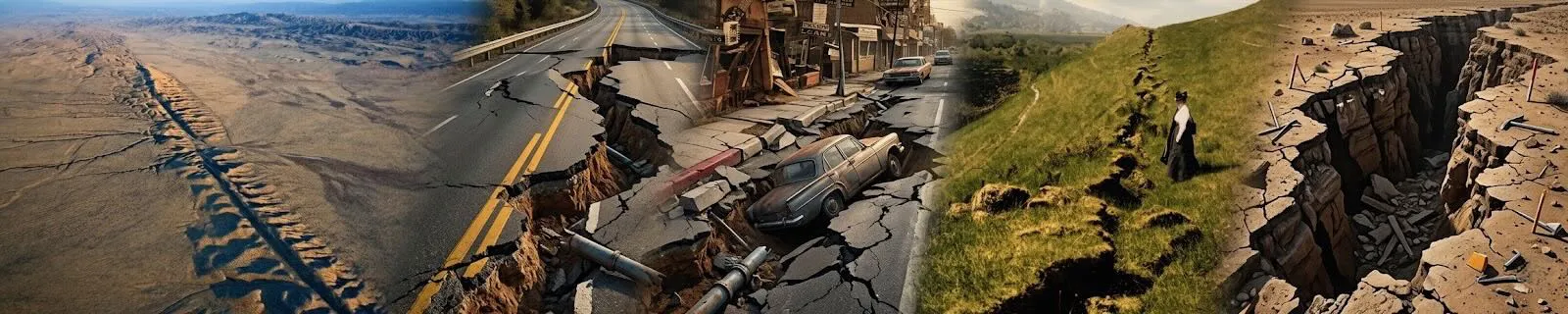
In the event of a major earthquake, Hollister would face several hazards. Liquefaction, where saturated soil temporarily loses its strength and behaves like a liquid, could occur in areas with loose, water-saturated soils. Landslides could be a risk in hilly or unstable terrain. Building and freeway collapse would be a concern, particularly in older structures or those not built to modern seismic standards. Fires could also result from broken gas lines or electrical faults.
The areas around Hollister most likely to experience severe shaking in a large quake would be those closest to the major fault lines, particularly the San Andreas Fault and the Calaveras Fault Zone. The intensity of shaking generally decreases with distance from the fault, but local geological conditions can amplify the effects.
Over the last century, Hollister has experienced several notable earthquakes. The 1906 San Francisco earthquake, which was centered on the San Andreas Fault, was felt in Hollister and caused significant damage throughout the region. The 1989 Loma Prieta earthquake, while centered farther north, also had effects felt in Hollister, demonstrating the wide reach of seismic activity in this fault-ridden area.
Overall, Hollister is situated in a seismically active region with multiple fault lines contributing to its earthquake risk. The city must be prepared for the potential impacts of major earthquakes, including shaking, ground failure, and structural damage.
Hollister Faults Map
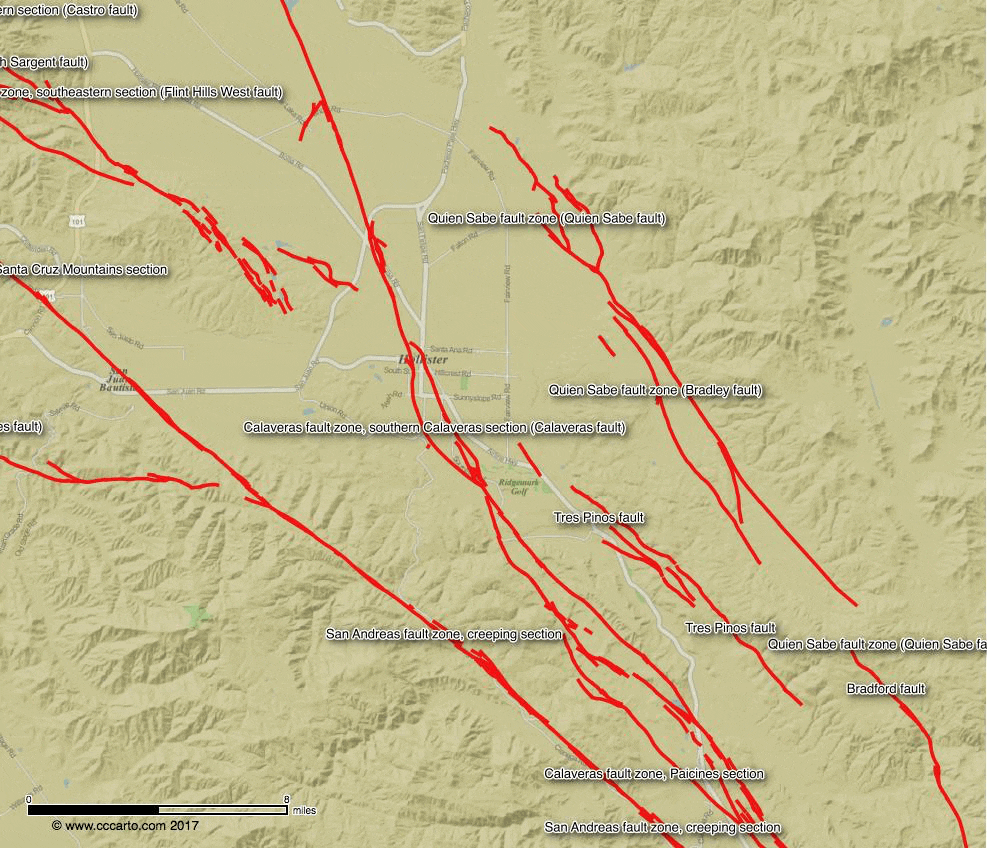
Hollister,California sits on the Calaveras fault zone and inland from Hollister right next to the San Andreas Fault Creeping and Santa Cruz Mountain sections. Many sidewalks, walls, buildings, curbs and streets in the area are slowly moving apart due to the slow and steady fault movement.
Fault Attributes Key
NAME is an 80-character field for the name of the fault (including section name, i.e., Denali fault, Holitna section). Fault and section are lower case.
CODE is a three-integer field that defines certainty or reliability of field mapping (integer one), time of most recent movement (integer two), and amount or rate of slip (integer three). CODE is a composite of the single integer fields ACODE, SLIPCODE, and FCODE and determines the line type (fault trace) to be plotted.
NUM is a six-character unique USGS identifier that defines a fault or section ID. Simple fault IDs are only numeric; section IDs are alphanumeric.
AGE is the upper bounding time of the most recent surface-deforming earthquake. The allowable choices are provided in a pull-down menu.
ACODE is the second integer in CODE and defines the upper bounding time of the most recent surface-deforming earthquake. Permissible values are between 1 and 6: 1 = historic «150 years; red = cmyk 1096680); 2 = post glacial (15,000 years; orange = cmyk 1 38 1000); 3 = late Quaternary «130,000 years; green> cmyk 1002500); 4 = middle and late Quaternary «750,000 years: blue > cmyk 1004440); 5 = Quaternary «1,600,000 years; black 5); 6 = Class B (black halftone). In the text documentation, Quaternary faults (integer two, 1-5) are Class A structures. Questionable or suspected structures are Class B (integer two, 6).
SLIPRATE is the assigned slip rate category.
SLIPCODE is the third integer in CODE and defines the assigned slip rate category. Permissible values are between 1 and 4 and determine line width: 1 = >5 mm/year (extra wide; .048); 2 = 1-5 mm/year (wide; .0325); 3 = 0.2-1 mm/year (medium; .025); 4 = <.2 mm/year (thin; .015).
SLIPSENSE is normal, reverse, strike slip, thrust.
DIPDIRECTION is one of the eight quadrant dip directions for the entire fault or section, not the individual arc. C = center, E = east, N = north, NE = northeast, NW = northwest, S = south, SE = southeast, SW = southwest, W = west.
SLIPDIRECT (we are not using that field anymore and can be left empty) FCODE is the first integer in CODE and defines how well the fault is located and expressed in the landscape. Permissible values are between 1 and 3: 1 = fault landforms are more continuous than discontinuous and mapping is accurate at given MAPPEDSCALE (solid); 2 = fault landforms are more discontinuous than continuous and mapping is accurate at given MAPPEDSCALE (dashed); 3 = location of fault is inferred (dotted).
FTYPE is one of three allowable choices provided in a pull-down menu: Well constrained (FCODE 1), Moderately constrained (FCODE 2), and Inferred (FCODE 3).
MAPPEDSCALE is one of four allowable choices provided in a pull-down menu. Mapped scale will control visualization of the fault at various scales. 1:24,000, fault should be more continuous than discontinuous and mapping is accurate at <10,000 scale. 1:50,000, fault should be more continuous than discontinuous and mapping is accurate at <25,000 scale. 1:100,000, fault could be more discontinuous than continuous and mapping is accurate at <50,000 scale. 1:250,000, fault location may be inferred or is poorly constrained.
Click on the fault lines for more information. Note* The earthquake faults are color-coded by unique name and section not type.
Data source: USGS
CCCarto is not responsible for data errors or omissions, use as reference only.
Copyright cccarto.com 2026