An overwater bungalow is a freestanding structure, typically built on sturdy pilings directly above the water of a lagoon, ocean, or sea. Unlike traditional stilt houses used by indigenous coastal communities for centuries, the modern "overwater bungalow" is specifically designed for luxury accommodation.
They first appeared in the late 1960s in French Polynesia. Three American friends, known as the "Bali Hai Boys," built the first iterations on the island of Moorea in 1967. They wanted to attract visitors to a property that lacked a traditional sandy beach, so they built outward over the lagoon, inadvertently creating a global tourism phenomenon.
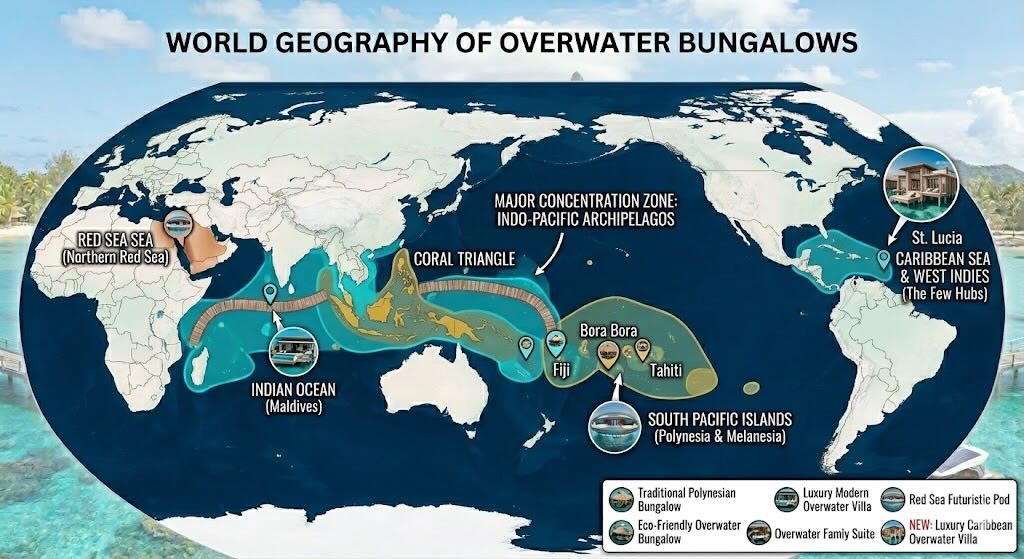
Overwater bungalows Regions Map.
Where Are They Found?
Overwater bungalows require specific physical geography to survive and function: shallow, calm, clear waters protected from heavy ocean swells. Therefore, they are almost exclusively found in tropical lagoons, coral atolls, and highly sheltered bays. These specific hydrographic conditions dictate their presence, keeping them close to the equator where reef structures naturally break the open ocean waves before they reach the shoreline.
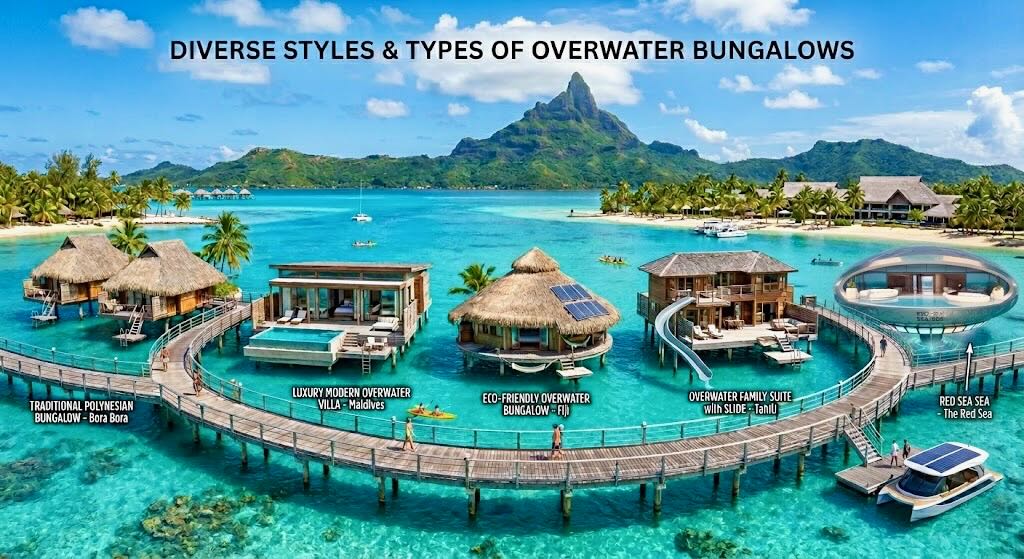
Overwater bungalow Styles and Designs.
Types and Construction Materials
While early bungalows were rustic, today's structures range from eco-friendly huts to massive luxury villas. The construction heavily depends on the local environment and the scale of the resort:
Traditional/Rustic: Built using local hardwoods for pilings, with woven palm frond or pandanus thatch for roofing. These blend into the natural sightlines but require constant maintenance.
Modern Luxury: Often utilize reinforced concrete pilings driven deep into the seabed or reef, topped with steel frames, imported storm-resistant woods, and signature features like reinforced glass-bottom floors to view marine life.
Regions Known for Overwater Bungalows
While the concept originated in the South Pacific, the overwater bungalow has evolved into a global architectural phenomenon. Today, these structures can be found across a diverse range of topographic and climatic conditions, spanning from ultra-luxury eco-resorts to rustic, community-run homestays:
The Maldives: The undisputed global capital of overwater architecture. Boasting hundreds of resorts spread across its vast network of coral atolls, the Indian Ocean dictates the design here. Accommodations range from classic thatched-roof villas to sprawling, multi-story aquatic mansions featuring private water slides, glass-bottom floors, and even underwater bedrooms.
French Polynesia (Bora Bora, Moorea, Tahiti): The historic birthplace of the overwater bungalow in the 1960s. This region remains the iconic, classic destination, famous for the dramatic visual juxtaposition of shallow, neon-blue lagoons set against jagged, emerald-green volcanic peaks like Mount Otemanu.
Fiji and the South Pacific: Featuring highly secluded, luxury-focused structures locally known as bures. These bungalows frequently emphasize indigenous design elements, utilizing traditional thatched roofs, woven coconut palm leaves, and local timber, heavily catering to intimate, romantic, and eco-conscious travel.
The Red Sea (Saudi Arabia & Egypt): A rapidly emerging frontier for hyper-luxury and regenerative tourism. New mega-projects, particularly along the Saudi Arabian coast, are introducing futuristic, highly sustainable overwater villas suspended above untouched archipelagos. This region offers exclusive access to some of the world's most pristine, vibrant, and resilient coral reef systems.
The Caribbean and Central America: A booming market adapting the Pacific style to Atlantic waters. Destinations like Belize's offshore cayes, Jamaica, Mexico's Riviera Maya, and Panama's Bocas del Toro offer bungalows suspended over vibrant barrier reefs or tucked into calm, ecologically rich mangrove bays.
Mabul Island (Malaysia): Situated in the Celebes Sea just off the coast of Borneo, Mabul presents a highly dive-centric overwater experience. Known for its proximity to the legendary Sipadan Island, Mabul features a mix of luxury water villages and stilted dive lodges built directly over shallow, muck-diving reefs, catering to scuba divers and macro-photography enthusiasts.
Mansuar Island Homestays (Raja Ampat, Indonesia): A stark, beautiful contrast to luxury mega-resorts. The Papuan homestays on Mansuar Island consist of rustic, locally owned wooden huts built on stilts over the water. They offer intrepid travelers an authentic, low-impact, and highly immersive eco-experience, giving guests direct step-off access to the undisputed epicenter of global marine biodiversity.
Tourism vs. Living
Historically, indigenous maritime cultures (like the Bajau people of Southeast Asia) have lived in functional stilt houses over water for daily survival and fishing. However, the specific "overwater bungalow" you see on maps today is almost 100% dedicated to the luxury tourism and hospitality industry. They are designed for short-term vacationers seeking direct, private access to the ocean, rather than permanent residential living.
Environmental Footprint and Impacts
Constructing massive hospitality infrastructure over delicate marine ecosystems carries a severe environmental cost. The development process physically alters the local hydrography, permanently changes the benthic topography, and introduces long-term ecological stressors to otherwise pristine atolls and lagoons:
Reef Destruction and Benthic Habitat Loss: The immediate physical footprint of a resort is devastating to the local seabed. Driving hundreds of reinforced concrete pilings deep into the reef foundation physically crushes ancient coral heads and fractures the underlying limestone substrate. Furthermore, the sprawling architectural footprint above the water creates permanent artificial shading; this blocks vital sunlight from reaching the seabed, effectively killing light-dependent soft and hard corals, and decimating the expansive seagrass meadows that serve as crucial nurseries for marine life.
Dredging and Man-Made Hydrography: To accommodate supply barges and luxury yachts, resorts often dredge deep, unnatural channels through shallow lagoons. This severe bathymetric alteration creates permanent scars on the underwater topography. The dredging process itself kicks up massive sediment plumes that drift with the tide, settling on and suffocating nearby coral colonies. Additionally, the unnatural movement of sand to build artificial beaches or expand tiny islets alters the lagoon's natural tidal flow and wave energy dissipation.
Point-Source Pollution (Water and Air): High-density resorts act as localized epicenters of pollution. They introduce chemical contaminants directly into the marine environment, including nutrient-rich runoff from agricultural fertilizers used to maintain lush, non-native island landscaping. This runoff causes localized eutrophication, leading to algae blooms that further smother reefs. Massive amounts of toxic sunblock and poorly treated wastewater also change the localized water chemistry. Above the surface, the reliance on heavy diesel generators in these remote, off-grid locations creates localized air pollution and soot fallout.
Introduction of Invasive Species: The logistics of building and maintaining a luxury resort require importing massive amounts of foreign materials. Barges carrying construction timber, soil, and non-native ornamental plants frequently introduce invasive insects, rodents, and aggressive flora. Without natural predators, these invasive species quickly establish themselves, outcompeting and devastating the fragile, highly specialized endemic species of the atoll.
Visual, Spatial, and Light Disruption: From a spatial perspective, the sprawling geometric geometry of wooden walkways, concrete sea walls, and reclaimed airstrips creates severe visual pollution, interrupting the natural, organic sightlines of the coast. At night, the intense artificial lighting from the bungalows and pathways bleeds into the water and sky, disrupting the navigational instincts of nocturnal marine life, particularly hatching sea turtles and migratory birds.
Hazards of Sea-Level Accommodation
Staying in a freestanding structure directly over the open ocean in highly remote geographic zones presents a unique set of environmental and logistical risks that are often obscured by the luxury aesthetic:
Extreme Weather Vulnerability: Because overwater bungalows sit exactly at sea level, often with zero natural topographic protection (like hills or cliffs) to break the wind, they are profoundly vulnerable to extreme weather. They face the unmitigated brunt of storm surges, tropical cyclones, typhoons, and hurricanes. In extreme geological events, their location on the outer edges of coral shelves makes them highly susceptible to tsunami impacts.
Intense Solar Radiation: The geographic location of these resorts (almost exclusively near the equator) combined with the physical environment creates a severe UV hazard. The high albedo (reflectivity) of the white coral sand and the shallow turquoise water essentially acts as a mirror, amplifying the sun's rays from all angles. This drastically increases the risk of severe sunburns, heatstroke, and dehydration for guests unaccustomed to such intense, multi-directional solar exposure.
Proximity to Marine Predators: While shallow, sandy lagoons are generally clear and safe, the placement of certain bungalows can increase wildlife risks. Structures built near the edges of dense mangrove forests, at the mouths of freshwater rivers, near estuaries, or close to steep bathymetric drop-offs put guests in the direct hunting territories of aggressive, shallow-water predators like bull sharks and saltwater crocodiles.
Extreme Geographic Isolation and Healthcare Delays: The primary appeal of these locations—their remoteness—becomes their greatest hazard during a medical crisis. These islands are often hundreds of miles from modern, mainland healthcare facilities. Evacuation requires a speedboat or a seaplane. Crucially, seaplanes operate under strict Visual Flight Rules (VFR) and cannot fly at night; a major medical emergency occurring after sunset can mean waiting until dawn for a life-saving medevac.
Endemic Disease and Maritime Security: In developing or heavily forested tropical regions, the environment is a natural vector for mosquito-borne illnesses such as Dengue Fever, Chikungunya, and Malaria, especially where artificial landscaping creates pockets of standing water. Furthermore, the extreme isolation of these high-value luxury assets in economically depressed or politically unstable regions can, historically, make them vulnerable targets for maritime theft, piracy, or organized robbery, as local law enforcement is simply too far away to respond effectively.